Table of Contents
- Step 1: Identify Crabgrass Before You Treat It
- Step 2: Nail Crabgrass Preventer Timing
- Step 3: Choose What Kills Crabgrass but Not Grass
- Step 4: How to Get Rid of Crabgrass in Summer
- Step 5: Crabgrass Removal by Hand and Spot Treatment
- Step 6: Apply Herbicide Safely and Avoid Spray Drift
- Step 7: A Month-by-Month Crabgrass Control Calendar
- Step 8: Judge Your Results and Stop Repeat Applications
- Frequently Asked Questions
Last Updated: October 18, 2026
Step 1: Identify Crabgrass Before You Treat It
Crabgrass removal starts with knowing what you're pulling. Crabgrass is a warm-season annual grass that spreads outward from a center point, forming flat, star-shaped clumps. Its stems branch from a central crown, and seed heads appear as thin, finger-like spikes in late summer.
The biggest mistake we see is treating the wrong grass. Many homeowners spray fescue or St. Augustine, mistaking it for a weed.
Crabgrass vs. Tall Fescue and Other Lawn Grasses
Look at how the plant grows. Crabgrass grows in a rosette pattern, flat and spreading. Tall fescue grows upright in tight bunches. Crabgrass leaves are wider and lighter green.
Pull one blade and check the base. Crabgrass stems are smooth and slightly flattened. Fescue feels rounder and rougher.
Here's a quick comparison:
Feature | Crabgrass | Tall Fescue |
|---|---|---|
Growth habit | Flat, spreading rosette | Upright bunch |
Leaf width | Wide, light green | Fine, dark green |
Stem base | Smooth, flattened | Rounded, rough |
Root structure | Shallow, fibrous | Deep, fibrous |
Get this step wrong and every treatment after it fails. Confirm the plant before you spray.
Step 2: Nail Crabgrass Preventer Timing
Crabgrass preventer timing decides whether you win or waste money. Pre-emergent herbicide must go down before crabgrass seeds germinate.
The trigger is soil temperature. Crabgrass seeds sprout when soil at one inch deep stays around 55°F for several days.
Your local extension office publishes soil temperature guidance for your region. Check the extension service soil temperature resources for timing benchmarks.
Reading Soil Temperature and the Spring Window
Use a soil thermometer, not the air forecast. Stick it two inches into the soil and check it mid-morning for several days.
Apply pre-emergent when soil hits 50-55°F. That gives the product time to form a barrier before seeds wake up.
- Apply too early: barrier breaks down before germination
- Apply too late: seedlings already sprouted
- Split applications: a second round 6-8 weeks later extends control
Water the product in lightly after application. Most labels call for about a quarter inch of water to activate the barrier.
Step 3: Choose What Kills Crabgrass but Not Grass
What kills crabgrass but not grass? The answer is a selective herbicide. Selective products target crabgrass while leaving your turf alone. Non-selective products kill everything they touch.
Pre-emergent herbicides stop seeds from sprouting. Post-emergent herbicides kill plants that already sprouted. Use pre-emergent in spring, post-emergent for escapes. Within each category, the active ingredient determines which grass types you can safely treat and which growth stages you can hit.
Pre-Emergent vs. Post-Emergent Active Ingredients
Active ingredients matter more than brand names. Here is how the main options compare:
Type | Common Active Ingredient | Best For | Timing | Turf Notes |
|---|---|---|---|---|
Pre-emergent | Prodiamine | Spring barrier | Soil at 50-55°F | Labeled for most established cool- and warm-season turf; not for newly seeded lawns |
Pre-emergent | Dithiopyr | Early spring, some seedling control | Soil at 50-55°F | Also has early post-emergent activity on very young crabgrass; check overseeding restrictions |
Pre-emergent | Pendimethalin | Spring barrier | Soil at 50-55°F | Effective barrier; label restricts use around certain newly planted turf |
Post-emergent | Quinclorac | Young crabgrass | 2-4 leaf stage | Labeled for many turf types but restricted on some warm-season grasses; read the label |
Post-emergent | Fenoxaprop | Established clumps | Active growth | Effective on crabgrass; can injure some desirable grasses, confirm turf compatibility |
Post-emergent | Mesotrione | Young crabgrass, some broadleaf weeds | Early post stage | Useful where overseeding is planned; check label for turf and seeding intervals |
Match the Product to Your Grass Type
Not every product suits every grass type. The label lists the turfgrasses the product is registered for, and applying outside that list can thin or kill your lawn. A common pattern is that products labeled for cool-season turf, tall fescue, Kentucky bluegrass, perennial ryegrass, are not automatically safe on warm-season grasses such as St. Augustine, centipede, and carpetgrass. Some post-emergents harm St.
Before you buy, do three things:
- Confirm your grass type. If you are unsure, your local extension office can help you identify it from a sample or photo.
- Read the label's turfgrass list and the restrictions section, not just the mixing instructions.
- Check the seeding and overseeding interval. Many pre-emergents prevent grass seed from sprouting, which is the point for crabgrass but a problem if you plan to overseed.
Why Selective Products Spare Your Lawn
Selective herbicides exploit differences in how grass and weed species absorb, metabolize, or detoxify the active ingredient. Your desirable turf breaks down the chemical or is less sensitive to it, while crabgrass is not. That selectivity is dose- and species-dependent, which is why the label rate and the labeled turf list matter. Mixing stronger than the label rate does not improve crabgrass control reliably and increases the chance of turf injury.
What to Do If You Are Unsure
If your lawn is a mix of grass types, or you are treating around ornamental beds, choose the product with the narrowest labeled use that still covers your target and spot-treat rather than broadcasting. When in doubt, apply to a small test area first and watch for yellowing or thinning before treating the whole lawn.
Step 4: How to Get Rid of Crabgrass in Summer
How to get rid of crabgrass in summer comes down to catching it young. Young crabgrass is easy to kill.
Spray post-emergent when plants have 2-4 leaves. At that stage, quinclorac works well. Once plants mature, you may need a second application or hand removal.
Summer heat stresses grass. Spray on a calm, cool morning to reduce turf damage. Water the lawn deeply once a week instead of lightly every day.
- Spray young plants first
- Re-treat survivors after two weeks
- Mow high to shade the soil surface
Step 5: Crabgrass Removal by Hand and Spot Treatment
Crabgrass removal by hand works best on small patches. Grab the clump at the base and pull with a twisting motion. Get the crown, or it grows back.
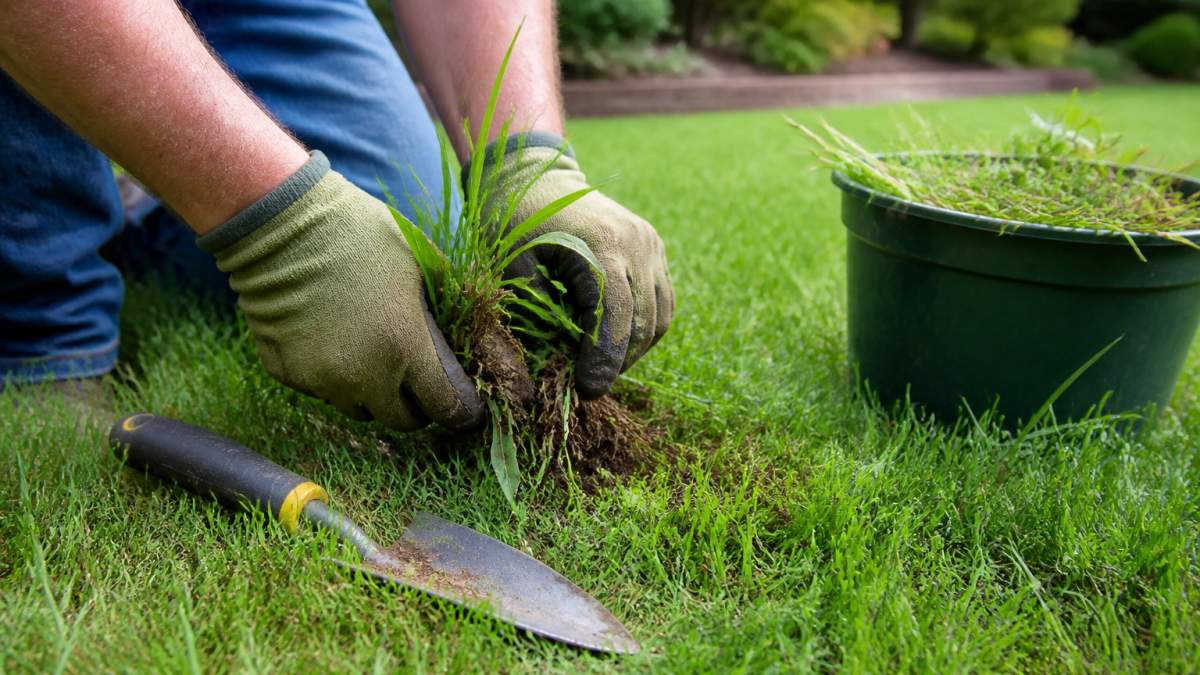
For spot treatment, spray individual clumps instead of the whole lawn. Spot spraying saves product and limits damage to nearby turf. Pull weeds before they set seed, or you'll be back at it next spring.
- Water the area the day before pulling
- Pull slowly to get the crown
- Fill bare spots with seed or sod
Step 6: Apply Herbicide Safely and Avoid Spray Drift
Spray drift damages nearby plants and wastes product. Spray on calm days with wind under 5 mph.
Protect yourself and your family. Wear gloves, long sleeves, and eye protection. Keep pets and children off treated areas until the product dries.
The EPA guidance on safe pesticide use covers label rules and protective equipment. Follow the product label exactly. The label is the law.
- Never spray on windy days
- Shield desirable plants with cardboard
- Store products out of reach of children
Step 7: A Month-by-Month Crabgrass Control Calendar
A calendar keeps crabgrass control on track. Here's how the year breaks down:
Month | Task |
|---|---|
March | Check soil temperature, apply pre-emergent |
April | Water in barrier, watch for seedlings |
May | Spot-treat young plants |
June | Re-apply pre-emergent if needed |
July | Hand-pull or spot-spray survivors |
August | Stop seed heads from forming |
September | Overseed bare spots |
October | Fertilize to thicken turf |
A thick lawn is your best defense. Fertilize at the right time, mow high, and water deeply. Healthy turf crowds out crabgrass before it gets a foothold.
Mow your lawn at the tallest height your grass type allows. Taller grass shades the soil, keeps crabgrass seeds cooler, and blocks light from reaching new seedlings.
Step 8: Judge Your Results and Stop Repeat Applications
Judging results is not just about whether the crabgrass turned brown. It is about whether you are on a path to a lawn that stops new crabgrass from establishing. Treat killing crabgrass as one step in a sequenced plan, not the finish line.
What to Monitor After Treatment
Check treated areas about two weeks after application. Look for yellowing, wilting, and collapse of the clumps. Post-emergent activity on young crabgrass often shows within one to two weeks under active growth; established clumps and cooler weather can slow the response. If plants are still green and growing after the label's expected window, the product missed, the rate was off, or the timing was wrong, not necessarily that you need to spray again immediately.
- Yellowing and wilting: product is working; wait out the label window before judging.
- Green, upright, and growing: suspect a miss, wrong growth stage, or rainfastness issue.
- New seedlings emerging: your pre-emergent barrier may have broken down or was not activated.
When a Repeat Application Is Appropriate
Repeat applications are governed by the label, not by frustration. Most labels set a maximum number of applications per season and a minimum interval between them. Follow both. Re-applying before the interval or above the seasonal maximum wastes money and stresses turf. If the label allows a second application, time it to the crabgrass growth stage you are targeting and to the interval, not to a calendar guess.
Record the date, product, active ingredient, rate, and area treated. That log tells you when you are eligible for a repeat application and helps you avoid using the same active ingredient back-to-back, which can contribute to resistance and repeat failures.
The Integrated Plan: Remove, Repair, Prevent
Once the crabgrass is dead, the bare spot it leaves is an invitation for the next seed. Sequence the follow-through:
- Remove the dead clump and any seed heads. Bag seed-bearing material rather than leaving it on the lawn.
- Repair the bare spot. In fall, overseed with a turfgrass suited to your lawn and climate; in spring, use sod or a starter patch if overseeding conflicts with your pre-emergent schedule.
- Address compaction. Aerate compacted areas so new grass roots can establish.
- Water deeply and less often to encourage deep roots in the repaired turf.
- Fertilize on a schedule appropriate for your grass type to thicken the stand.
- Mow high to shade the soil surface and keep crabgrass seeds cooler.
Realistic Timelines
A single season rarely converts a thin, crabgrass-prone lawn into a dense one. A common pattern is that year one reduces the infestation, year two shows fewer escapes as turf thickens, and year three is maintenance.
- Overseed bare spots in fall
- Aerate compacted soil
- Water deeply once a week
At Everett Lawn Care, our licensed and insured team handles weed control, aeration, and seasonal cleanups for properties across the Triangle. We tailor treatments to your grass type and soil, so you're not guessing at timing or products.
Frequently Asked Questions
What kills crabgrass but not your lawn?
Selective post-emergent herbicides labeled for your grass type are the answer for lawns already up. Products containing quinclorac or 2,4-D are commonly used on cool-season turf, while fenoxaprop and similar actives are options for many warm-season grasses. Always read the product label to confirm your grass type is listed, because the same active ingredient can injure St. Augustine or centipede. For prevention, a pre-emergent applied before soil temperatures hit 55°F stops crabgrass seeds from sprouting without touching established turf.
When should I apply crabgrass preventer?
Apply crabgrass preventer when soil temperatures at a 2-inch depth reach about 55°F and stay there, which usually happens in early to mid-spring. In the Triangle area, that window often falls in March. The product needs to be watered in to form a barrier in the top layer of soil before crabgrass seeds germinate. Applying too early wastes the barrier; applying after seedlings emerge means you have missed the window and should switch to a post-emergent plan instead.
Is July too late to kill crabgrass?
No, July is not too late, but the approach changes. By mid-summer crabgrass is established and has likely gone to seed, so pre-emergents will not help. Use a selective post-emergent labeled for your grass type, spot-treat individual patches, and hand-pull small clumps after rain when the soil is soft. Expect to repeat spot treatments through the growing season. Plan a fall overseeding or spring pre-emergent program to stop the seeds dropped this summer from returning next year.
How do you remove crabgrass by hand without it coming back?
Water the area the day before so the soil is soft, then grasp the crabgrass at the base and pull slowly, working the roots out rather than snapping the stem. Crabgrass roots shallow but spreads outward, so a weeding fork helps lift the crown. Bag the pulled plants instead of leaving them on the lawn, since seed heads can still mature. Follow up by thickening the turf with fertilizer and proper mowing height so bare spots fill in and seeds have less room to grow.
Crabgrass control takes patience and the right sequence: identify, time your preventer, choose a selective product, and fix thin turf. If the process feels like more than you want to manage, Everett Lawn Care can take it off your plate. Our licensed and insured crew offers expert lawn aeration, customized lawn maintenance, and professional landscape design built around your property. Get a free estimate and let us help your lawn look its best.