Table of Contents
- Why Expert Lawn Aeration for Landscaping Starts With Soil Compaction
- Lawn Core Aeration vs. Spike Aeration: What Actually Works
- Aftercare Timeline and Common Mistakes to Avoid
- Frequently Asked Questions
Last Updated: October 21, 2026
Why Expert Lawn Aeration for Landscaping Starts With Soil Compaction
Expert lawn aeration for landscaping begins with a single diagnosis: compacted soil. When soil particles are pressed together, the pore spaces that hold air and water collapse, and grass roots suffocate in ground that behaves more like concrete than a growing medium.
Compaction rarely announces itself. At Everett Lawn Care, we treat aeration as a soil correction first and a cosmetic service second.
How Compaction Starves Grass Roots
Grass roots need three things from soil: oxygen, water, and dissolved nutrients. Compaction chokes all three at once. Water that should infiltrate downward instead pools on the surface or runs off, carrying fertilizer with it.
The causes are ordinary: foot traffic, mower wheels, parked vehicles, construction equipment, and the heavy clay soils common across the region. A lawn that feels hard underfoot or sheds water in sheets is telling you the pore structure is gone.
Lawn Core Aeration vs. Spike Aeration: What Actually Works
Core aeration removes small plugs of soil and thatch from the ground, while spike aeration pushes solid tines into the turf without removing anything.
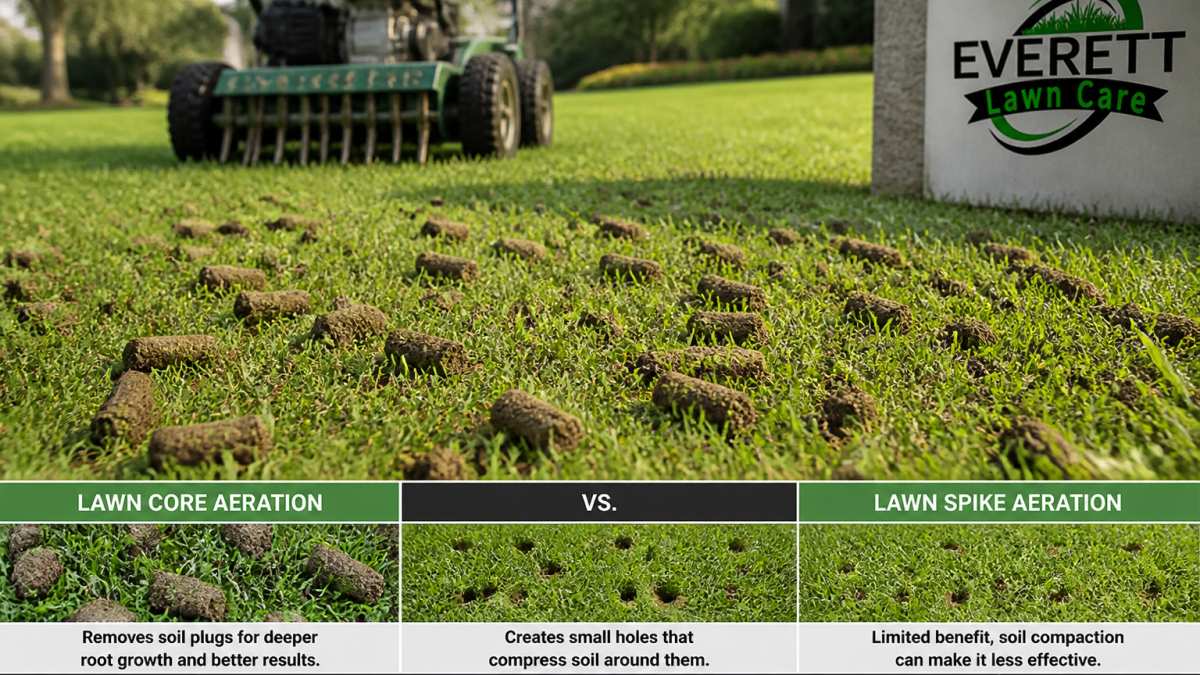
Core aeration, or hollow-tine aeration, pulls cylindrical soil cores to the surface and leaves them to break down, opening a direct channel through thatch into the root zone.
(/blog)'s [aeration and seeding service](https://www.everett-lawncare.com/aeration-seeding/) handles timing, equipment, and aftercare, and our [soil testing](https://www.everett-lawncare.com/soil-testing/) confirms whether compaction is the actual problem before we recommend a pass.Aftercare Timeline and Common Mistakes to Avoid
Aftercare determines whether aeration pays off. Water lightly right after aerating, keep traffic off the fresh holes for a few days, and let plugs break down naturally rather than raking them up.
What to avoid:
- Aerating during dormancy. No recovery, and open holes invite weeds.
- Aerating bone-dry soil. Ragged holes and no real relief.
- Skipping water afterward. Fresh holes dry out fast and stress the turf.
- Aerating every month. Once a year, timed to the grass type, is the norm.
Do these right and turf recovery follows within a couple of weeks, with denser growth and better water infiltration as the holes close.
Frequently Asked Questions
What is the best month to aerate a lawn?
It depends on your grass. For cool-season grasses like fescue, the best window is early fall, roughly late August through October, while the grass is actively growing and temperatures are dropping. For warm-season grasses like Bermuda and Zoysia, late spring to early summer works best, once the grass has fully greened up and is growing strongly. Aerating outside these windows, especially during dormancy or peak summer heat, slows recovery and can leave the lawn exposed to weeds and stress.
How much should I pay to have my lawn aerated?
Pricing for a professional lawn aeration service depends on lawn size, soil type, access, and whether overseeding is included, so quotes vary from property to property. Rather than guessing at a number, ask for a written estimate that spells out what is covered: which machine is used, how many passes, whether plugs are left on the lawn, and whether seed or fertilizer is part of the visit. Everett Lawn Care provides free estimates so you can compare scope, not just a headline figure.
Is lawn aeration really worth it?
For compacted soil, thin turf, or lawns with heavy thatch, aeration is often the difference between grass that struggles and grass that fills in. Core aeration pulls soil cores out, which opens the root zone to air, water, and nutrients and gives roots room to expand. On a lawn that is already loose and healthy, the benefit is smaller. A simple screwdriver test, pushing a blade into the soil, tells you quickly whether compaction is actually a problem worth treating.
What should you do after lawn aeration?
Water the lawn lightly after aeration to help the soil cores break down and to settle the surface. If you are overseeding, apply seed right after aerating so it falls into the holes, then keep the top inch of soil consistently moist until germination. Hold off on heavy foot traffic and mowing for a few days, and skip weed-and-feed products immediately after, since the open holes can push herbicide into the root zone. A light topdressing can help seed-to-soil contact.
Most lawns don't fail because of mowing or fertilizer; they fail because compacted soil never gets corrected. If your lawn feels hard, sheds water, or thins out in high-traffic areas, aeration is likely the missing step. Everett Lawn Care brings licensed, insured crews and commercial-grade equipment to read your soil, time the pass to your grass type, and handle the aftercare. Get a Free Estimate and let us put expert lawn aeration for landscaping to work on your property.