Last Updated: November 2, 2026
Quick Summary
October is not automatically too late to scarify lawn, but it sits on the edge of the safe window in most of the country. Early October often works for cool-season grasses when growth is still active, while late October usually does not. You need at least three to four weeks of good growing weather after the pass.
- Scarify when grass is actively growing, not dormant, and avoid the weeks right before the first expected frost.
- Cool-season grass needs about three to four weeks of active growth to recover from a light scarify.
- In northern states (USDA zones 3-5), October is often too late because first frost arrives by early to mid-October.
- Thatch over half an inch is worth addressing; over one inch is a serious problem.
- Scarifying too deep in October is the single most common mistake, ripping out healthy grass and leaving bare patches.
Table of Contents
- Why October Sits Right on the Scarifying Deadline
- The Best Time to Scarify a Lawn (and Where October Fits)
- 7 Signs Your October Lawn Can Still Handle Scarification
- How to Scarify a Lawn Without Burning Your Fall Recovery Window
- What to Do After Scarifying a Lawn in Cooler Weather
- Lawn Aeration vs Scarification: Which Does an October Lawn Need?
- If October Is Too Late, Here's Your Recovery Plan
- Get a Free Estimate Before Your Fall Window Closes
- Frequently Asked Questions
Why October Sits Right on the Scarifying Deadline
October is not automatically too late to scarify lawn, but it sits on the edge of the safe window in most of the country. The job works only when grass still has enough warm days left to recover before the first hard frost.
Here is the core tension. Scarification cuts through thatch and lifts moss and debris, which opens the soil surface. That is good in the right season. In the wrong one, it strips insulation and exposes crowns to cold.
October is best treated as a decision point, not a date on the calendar. The right call depends on your grass type, your local weather, and how much growth you have left.
The Best Time to Scarify a Lawn (and Where October Fits)
The best time to scarify a lawn is early fall for cool-season grasses and late spring for warm-season grasses. October falls inside the fall window for cool-season turf, but only in its early weeks and only when growth is still active.
Scarification is the mechanical removal of thatch, the layer of dead stems and roots that builds up between the grass and the soil. A thin layer protects the lawn. A thick one blocks water, air, and nutrients.
Timing rules of thumb:
- Scarify when the grass is actively growing, not dormant
- Leave at least three to four weeks of good growing weather after the pass
- Avoid the weeks right before the first expected frost
- Skip it during drought, heat stress, or waterlogged soil
That is why October is a split month. Early October often works. Late October usually does not.
Spring Versus Early Fall: Which Window Fits Your Grass
Spring scarification suits warm-season grasses that green up in late spring. Do it after full green-up, not during the flush.
Early fall scarification suits cool-season grasses. The soil is still warm, air temperatures drop, and the grass pushes new growth without summer heat stress. This window gives roots time to knit back before winter.
The table below sums up the trade-offs.
| Window | Best Grass Type | Main Advantage | Main Risk |
|---|---|---|---|
| Late spring | Warm-season | Full season to recover | Heat and drought stress |
| Early fall | Cool-season | Warm soil, cool air | Frost arriving too soon |
| October (early) | Cool-season | Good growth still active | Tight recovery window |
| October (late) | None ideally | Rarely justified | Bare patches into winter |
7 Signs Your October Lawn Can Still Handle Scarification
You can still scarify in October if most of these signs point the right way. But the signs alone are not enough, you need to read them together and factor in your local climate.
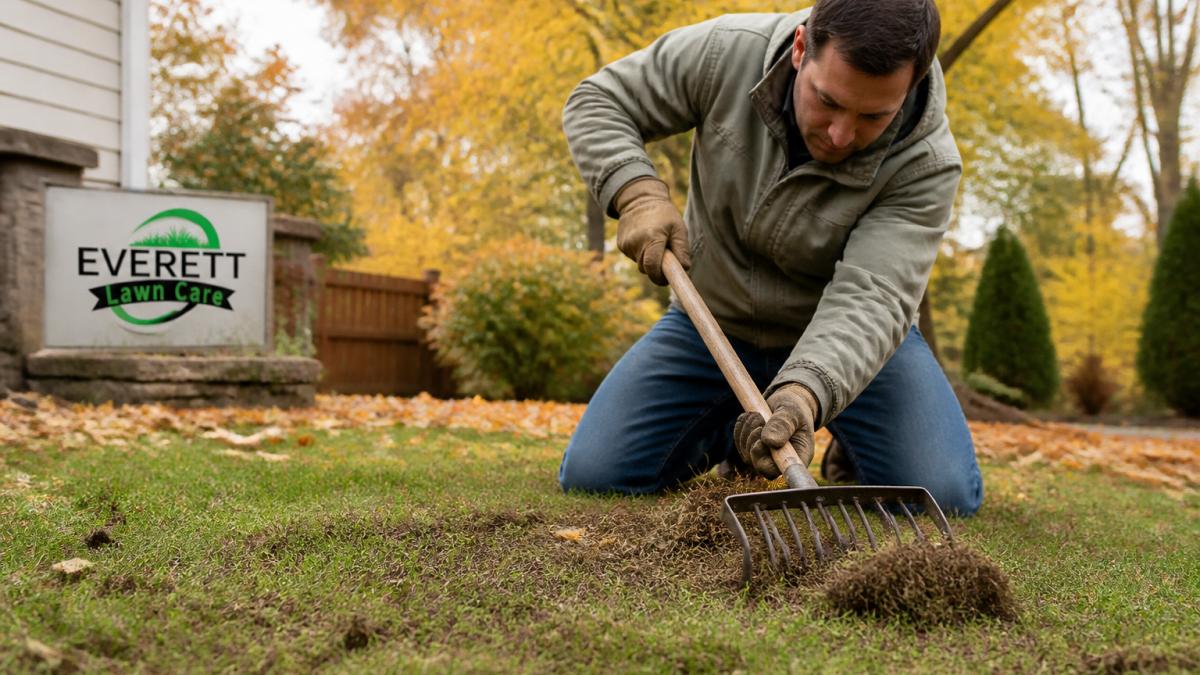
- The grass is still growing. You are still mowing and seeing fresh clippings. In cool-season turf, growth slows when soil temperatures drop below about 50°F. If you have not mowed in two weeks, growth has likely stalled.
- Daytime temperatures stay mild. Consistent daytime highs in the 60s and low 70s°F keep recovery on track. A cold snap below 50°F for several days can halt growth.
- No hard frost in the 14-day forecast. You want at least three to four weeks of good growing weather after the pass. A hard frost (below 28°F) kills top growth and stops recovery.
- The soil is moist but not soggy. Damp soil cuts cleanly; wet soil tears roots and compacts. Wait a day after rain, and avoid working soil that sticks to your boots.
- Thatch is visibly thick. A spongy surface and poor water penetration signal a real need. Thatch over half an inch is worth addressing; over one inch is a serious problem.
- Moss and weeds are crowding the turf. Scarifying opens space for grass to fill back in, but only if grass is still growing.
- You can water and feed after the pass. Aftercare is what drives recovery. If you cannot water consistently for two weeks, do not scarify.
How to use this guide by region:
- Northern states (USDA zones 3-5): October is often too late. First frost typically arrives by early to mid-October. Only early October with a warm forecast is viable, and only a light pass.
- Transition zone (zones 6-7): Early October can work for cool-season grasses if growth is active. Late October is risky. Watch for the first frost around late October to early November.
- Southern states (zones 8-9): October is often still fine for warm-season grasses, but scarify only after they have slowed growth and before they go dormant. For cool-season grasses in the South, October is early fall and generally safe.
Recovery time math: Cool-season grass needs about three to four weeks of active growth to recover from a light scarify. If your first frost is less than three weeks away, skip it. For heavy scarification, you need six to eight weeks, almost never available in October except in the warmest parts of the transition zone.
If you count four or more signs and your region allows, October is workable. If you count two or fewer, or if frost is imminent, wait. When in doubt, a light pass is always safer than a deep one.
How to Scarify a Lawn Without Burning Your Fall Recovery Window
Follow these steps to scarify lawn in October without wrecking your fall recovery.
- Mow low first. Cut the grass shorter than usual, about one third off the normal height, so the scarifier reaches the thatch.
- Check the soil. It should be moist, not soaked. Wait a day after rain.
- Set a shallow depth. Start light and make a second pass only if needed.
- Work in straight lines. Overlap each pass slightly for even coverage.
- Rake and remove debris. Bag the thatch so it does not smother the grass.
- Overseed bare spots. Seed thin areas right after scarifying so seed meets soil.
- Water gently. Keep the surface damp until new growth shows.
Watch out: scarifying too deep in October is the single most common mistake. It rips out healthy grass and leaves bare patches that cold weather will not heal.
If thatch is your main problem, Everett Lawn Care's lawn maintenance services can help assess it.
What to Do After Scarifying a Lawn in Cooler Weather
Aftercare decides whether an October scarify helps or hurts. The lawn is stressed, so give it what it needs to recover fast.
- Water consistently. Light, even watering keeps seed and crowns moist.
- Feed at the right time. Cool-season grasses benefit from fall feeding that supports root growth.
- Overseed thin areas. Seed while soil is still warm enough for germination.
- Keep off the lawn. Limit foot traffic for a week or two.
- Watch the weather. If a hard frost is coming, hold off on anything that stresses the turf further.
Timing your feed matters as much as the scarify itself. See when to fertilize fescue in Raleigh for a seasonal guide. Everett Lawn Care's lawn treatments can help coordinate feeding with recovery.
Lawn Aeration vs Scarification: Which Does an October Lawn Need?
Aeration and scarification solve different problems, and October often calls for one more than the other.
Aeration pulls cores from the soil to relieve compaction and improve air and water flow to the roots. It is gentler on the surface and safer later in fall.
Scarification removes thatch and moss from the surface. It is more aggressive and needs a longer recovery window.
If your lawn is compacted but not choked with thatch, aeration is often the better October move. It opens the soil without stripping the surface.
For a deeper look at the aeration side, see expert lawn aeration.
If October Is Too Late, Here's Your Recovery Plan
If the signs say wait, do not force it.
1. Leave the thatch for now. A moderate layer (up to half an inch) is not an emergency.
2. Aerate instead. Core aeration is safer in late fall and still relieves compaction.
3. Top-dress and overseed thin spots. Light work that supports the lawn without stripping it.
4. Control moss and weeds gently. Spot treatment beats a full reset this late.
5. Plan for spring. Mark the calendar for the next proper window.
6. Adjust your spring plan based on this fall. If thatch is thick, plan a light scarify in early spring, followed by overseeding.
Regional notes:
- North (zones 3-5): Spring scarification is risky because it can expose crowns to late frost. Wait until the lawn is fully green and growing. Fall is generally better, so if you miss October, aim for next early September.
- Transition (zones 6-7): You have two windows: early fall and late spring. If you miss fall, spring is a solid backup. Scarify after the last frost and when growth is strong.
- South (zones 8-9): For warm-season grasses, spring is the primary window. October is often still fine, but if you skip it, wait until late spring after full green-up. For cool-season grasses in the South, fall is best, so if you miss October, spring is second best.
A patient fall often beats an aggressive one.
Get a Free Estimate Before Your Fall Window Closes
The October window closes fast, and the right call depends on your grass, your soil, and your local weather. That is a lot to judge on your own.
Everett Lawn Care provides lawn care and landscaping services for homeowners and businesses, with licensed and insured experts and a local crew serving the Triangle area. Aeration, maintenance and seasonal cleanups are among the services available.
For current prices or a quote, visit Everett Lawn Care's website. Ready to book? Visit our professional landscaping services to get started.
Get a free estimate with Everett Lawn Care to discuss your lawn's needs.
Frequently Asked Questions
Is October too late to scarify a lawn?
It depends on your grass and the forecast, not the calendar alone. If daytime temperatures are still in the 60s and nights stay above roughly 40 degrees Fahrenheit, your grass has enough growing time to recover before the first frost. Cool-season grasses like tall fescue can often handle a light October scarify. If nights are already dipping toward freezing, wait until spring instead.
What happens if you scarify a lawn too late in the fall?
Scarifying exposes bare soil and stresses the grass. If frost arrives before the lawn knits back together, you can be left with thin turf, open ground for weeds, and winter kill in the bare patches. Recovery time matters more than the date: cool-season grass needs roughly two to four weeks of active growth after scarifying to fill back in.
How can I tell if my lawn needs scarifying?
Look for a spongy feel underfoot, a brown layer of thatch thicker than about half an inch, moss in shady spots, and grass that stays wet or dries slowly. If you can pull up a handful of dead material easily, thatch is building up. A light scarify once a year, in the right season, keeps that layer from smothering the grass.
Is aeration better than scarifying for a compacted lawn?
They solve different problems. Aeration pulls plugs to relieve compaction and open the soil, while scarification removes thatch and moss from the surface. A compacted lawn benefits most from aeration, and a thatchy one from scarifying. Many fall programs do both, but if October is tight on time, aeration is often the safer late-season choice because it stresses the grass less.
October does not have to be a gamble. Check the signs, keep any pass light, and put aftercare first. If the window is closing, let a local crew take the guesswork out of it. Get started with Everett Lawn Care and head into winter with a lawn that is set up to recover.
