Everett Lawn Care LLC

Professional Landscaping in Raleigh, NC

Everett Lawn Care provides mowing, aeration, seeding, sod installation, mulch, cleanups, landscaping, and pressure washing in Raleigh and Wake County.

Serving Raleigh, Cary, Apex, Holly Springs, Wake Forest, and nearby Triangle cities.

Request an estimate · Contact us · (919) 899-2341 · info@everett-lawncare.com

5300 Six Forks Rd, Raleigh, NC 27609

When to Fertilize Fescue in Raleigh: A Seasonal Guide

By Everett McLain

Table of Contents

Last Updated: October 19, 2026

Why Timing Matters for Tall Fescue in Raleigh

Tall fescue is a cool-season grass, and that one fact drives every decision about when to fertilize fescue in Raleigh. Our climate gives fescue two strong growth windows, fall and spring, and one long stretch of summer heat it has to survive. Feed it at the wrong time and you push weak top growth right before the heat hits.

The result is thin turf, more disease pressure, and a lawn that limps into September.

Timing is not a detail. It is the whole game.

Key Takeaway The single most important feeding of the year for tall fescue happens in fall, not spring. Spring nitrogen is a small top-up, never the main event.

Your Tall Fescue Fertilization Schedule, Month by Month

Here is the calendar we build around. Treat it as a framework, then adjust for weather and soil tests. The nitrogen targets below are pounds of actual nitrogen per 1,000 square feet, not pounds of product.

Month Action Nitrogen Target Trigger to Watch Notes
September Main fall feeding 1 lb N per 1,000 sq ft Soil still warm, air cooling, no 90-degree days in the 10-day forecast The anchor application of the year
October Optional second split 0.5-1 lb N per 1,000 sq ft Grass still actively growing, no frost yet Best if September was skipped or split
November Light late-fall dose 0.5 lb N per 1,000 sq ft Growth slowing but turf still green Supports winter color without soft growth
December-February No feeding None Dormant turf Roots still active; skip nitrogen
March Light spring feeding 0.5-1 lb N per 1,000 sq ft Active green-up, frost risk past Wait for steady growth, not a single warm week
April-May Small top-up or none 0.5 lb N per 1,000 sq ft max Stop by late May Heavy spring nitrogen backfires in summer
June-August No nitrogen None Heat stress period Water and mow only

September: The Most Important Feeding of the Year

September is the anchor of any tall fescue fertilization schedule. Soil is still warm from summer, air cools down, and the grass pushes new roots and tillers. This is when fescue recovers from summer and thickens up before winter.

Aim for about 1 pound of actual nitrogen per 1,000 square feet (Caring for Your Lawn and the Environment). Use a slow-release product so the grass feeds steadily for weeks instead of flushing all at once.

Wait for the first real cool-down. Applying in a 90-degree stretch wastes product and stresses the lawn. A practical trigger: when daytime highs settle into the low 80s and nights drop into the 60s, the grass is ready. If you can still fry an egg on the sidewalk, wait.

October Through November: The Second Fall Application

October extends the fall window. If you split your September feeding, this is the second half. If you skipped September, October is your chance. Split applications are safer than one heavy dose because they feed steadily and reduce the risk of runoff and burn.

November is a light touch. A small late-fall dose keeps color through winter without pushing soft growth that cold weather can damage. Keep it modest, around 0.5 pounds of nitrogen per 1,000 square feet, and only if the grass is still green and growing.

Pro Tip Late fall is the best time to pair feeding with aeration and overseeding. Opening the soil lets roots take up nutrients and new seed get good seed-to-soil contact in one pass.

March Through May: Light Spring Feeding With Limits

Spring feeding is where most lawns get into trouble. Fescue greens up on its own as soil warms. Heavy nitrogen now pushes lush top growth that cannot handle summer heat.

Keep spring light. One modest application around green-up, then stop by late May. Skip nitrogen entirely once the heat settles in. If your lawn is thin in spring, the better fix is a fall renovation, not a spring nitrogen binge.

How to Adjust the Calendar for Weather

Calendar dates are a guide, not a switch. Three adjustments cover most years:

  • Hot September: push the main feeding to late September or early October. Nitrogen applied into heat is wasted and can burn turf.
  • Dry fall: water before and after feeding. Dry soil slows nutrient uptake and can concentrate salts near roots.
  • Wet spring: skip the spring top-up if growth is already strong. Excess nitrogen plus wet weather invites disease.

A soil test takes the guesswork out of rates and product choice. Our soil testing service tells you what your lawn actually needs before you buy a bag.

Fall Fertilizer for Tall Fescue: What to Apply and When

Fall fertilizer for tall fescue should be nitrogen-forward with some phosphorus and potassium for root and stress support. A soil test tells you which of those you actually need.

Apply the main dose in September, a second in October if you split it, and a light late-fall dose in November. That is the whole fall program.

Watch Out Applying high-nitrogen fertilizer in late spring or summer is a common mistake. It forces soft growth that summer heat and disease tear apart, and can lead to damage all season.

How Much Nitrogen for Tall Fescue: Rates Per 1,000 Square Feet

Knowing how much nitrogen for tall fescue matters as much as timing. Too much pushes weak growth. Too little leaves the lawn thin.

Here are the rates we work from:

Instant Estimate →

  • Fall main feeding: 1 lb actual N per 1,000 sq ft
  • Fall split or late-fall dose: 0.5-1 lb per 1,000 sq ft
  • Spring feeding: 0.5-1 lb per 1,000 sq ft, once
  • Annual total: roughly 2-3 lbs N per 1,000 sq ft

Check the bag. The first number on the fertilizer label is the nitrogen percentage. A 20-pound bag of 20-0-10 holds about 4 pounds of actual nitrogen.

Fertilizing Newly Seeded Fescue: A Different Set of Rules

Fertilizing newly seeded fescue follows its own rules. New grass needs phosphorus and gentle nitrogen to build roots, not a heavy dose that burns tender seedlings. Treat establishment and maintenance as two separate programs.

At Seeding: Starter Fertilizer

Use a starter fertilizer at seeding. Starter products are lower in nitrogen and higher in phosphorus, which supports root development. A common approach is to apply according to the bag rate for new lawns, then water lightly to move nutrients into the seedbed. Do not exceed the bag rate hoping for faster results; more is not better with young roots.

After Germination: Light Feeding Only

Once seedlings are up and you have mowed a couple of times, feed lightly. A small dose of nitrogen, roughly 0.5 pounds of actual nitrogen per 1,000 square feet, helps the new grass fill in without pushing soft growth. Wait until the seedlings are tall enough to mow before any nitrogen beyond the starter.

Timing: Fall Seeding Fits the Calendar

Fall seeding fits this perfectly, since the new grass gets cool weather to establish before summer. Seed in early fall so roots develop before the first frost. If you must seed in spring, expect more watering and more competition from weeds, and keep nitrogen light until the stand is mature.

Establishment vs. Maintenance

The biggest mistake is treating a new lawn like an established one. Established lawns can take 1 pound of nitrogen per 1,000 square feet in a single fall application. New lawns cannot. Keep establishment nitrogen modest, rely on starter phosphorus, and do not apply high-nitrogen fertilizer until the new turf has been mowed several times and is actively tillering.

For established lawns that need thickening, our aeration and seeding service pairs well with a fall feeding plan.

Weather and Soil-Temperature Triggers to Watch

Calendar dates are a guide, not a switch. Watch the weather and soil temperature instead.

  • Fall feeding: soil still warm, air cooling, no 90-degree days in the forecast
  • Spring feeding: grass actively greening up, frost risk past
  • Skip feeding: heat waves, drought, or a lawn that is not actively growing

A soil test takes the guesswork out of rates and product choice. Our soil testing service tells you what your lawn actually needs before you buy a bag.

How to Apply Fertilizer and Care for the Lawn Afterward
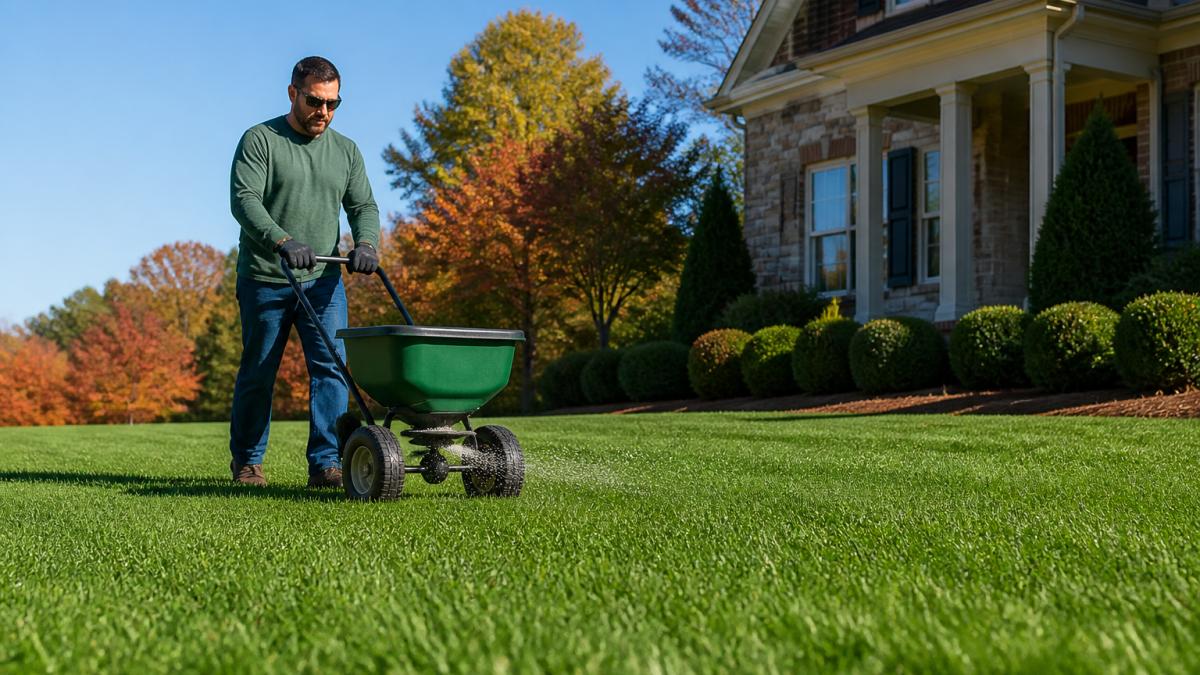
A homeowner in casual work clothes pushing a broadcast spreader across a lush green tall fescue lawn on a clear fall morning, with trees showing early autumn color in the background

Applying fertilizer well is simple if you follow a few steps.

  1. Set the spreader rate to match your target pounds per 1,000 sq ft.
  2. Split the pass into two directions for even coverage.
  3. Stay off the edges and keep product off hard surfaces.
  4. Water lightly after applying to move nutrients into the soil.
  5. Keep up weekly watering during dry spells to help uptake.

Mow at a steady height and leave clippings to return nutrients. For ongoing care, our lawn treatments follow this same seasonal logic.

Frequently Asked Questions

When should you fertilize tall fescue in Raleigh?

The most important feeding happens in early fall, usually mid-September through October, when cooler air and soil temperatures return and the grass begins active growth. A second lighter application in late fall, around November, helps root development through winter. Spring feeding should stay light and stop by late May. Avoid high-nitrogen applications in summer, when tall fescue is heat-stressed and pushing growth invites disease and drought damage.

How many times a year should you fertilize tall fescue?

Most established tall fescue lawns do well with two to three feedings per year. A typical tall fescue fertilization schedule is a heavier fall application in September, a second fall feeding in November, and a light spring application in March or April if the lawn needs a color boost. Lawns on poor soil or with heavy traffic may need a third application, but more than three feedings usually adds cost without improving turf quality.

Should you fertilize newly seeded fescue differently?

Yes. Fertilizing newly seeded fescue means using a starter fertilizer with a higher phosphorus ratio at seeding time, then following up about four to six weeks later once seedlings have established. Avoid heavy nitrogen on brand-new seedlings because it pushes top growth at the expense of roots. Keep the seedbed consistently moist with light, frequent watering until the grass reaches mowing height, then transition to deeper, less frequent irrigation.

Should you water tall fescue after applying fertilizer?

Watering after fertilizing helps granules dissolve and move into the soil where roots can use them. Apply about a quarter inch of water immediately after a granular application, or follow the product label directions. Avoid heavy watering that causes runoff. For the following two weeks, keep tall fescue on a weekly watering schedule of roughly one inch total, including rainfall, so the nutrients stay available and the lawn does not burn.


Getting fescue timing right takes local knowledge and a steady hand across all four seasons. That is exactly what a professional program delivers. Everett Lawn Care is licensed and insured, with a local crew serving the Triangle area. We handle customized lawn maintenance, expert aeration, soil testing, and treatments built around tall fescue's real needs. Get a free estimate from Everett Lawn Care and give your lawn the schedule it was always meant to have.

When to Fertilize Fescue in Raleigh: A Seasonal Guide

By Everett McLain

Table of Contents

Last Updated: October 19, 2026

Why Timing Matters for Tall Fescue in Raleigh

Tall fescue is a cool-season grass, and that one fact drives every decision about when to fertilize fescue in Raleigh. Our climate gives fescue two strong growth windows, fall and spring, and one long stretch of summer heat it has to survive. Feed it at the wrong time and you push weak top growth right before the heat hits.

The result is thin turf, more disease pressure, and a lawn that limps into September.

Timing is not a detail. It is the whole game.

Key Takeaway The single most important feeding of the year for tall fescue happens in fall, not spring. Spring nitrogen is a small top-up, never the main event.

Your Tall Fescue Fertilization Schedule, Month by Month

Here is the calendar we build around. Treat it as a framework, then adjust for weather and soil tests. The nitrogen targets below are pounds of actual nitrogen per 1,000 square feet, not pounds of product.

Month Action Nitrogen Target Trigger to Watch Notes
September Main fall feeding 1 lb N per 1,000 sq ft Soil still warm, air cooling, no 90-degree days in the 10-day forecast The anchor application of the year
October Optional second split 0.5-1 lb N per 1,000 sq ft Grass still actively growing, no frost yet Best if September was skipped or split
November Light late-fall dose 0.5 lb N per 1,000 sq ft Growth slowing but turf still green Supports winter color without soft growth
December-February No feeding None Dormant turf Roots still active; skip nitrogen
March Light spring feeding 0.5-1 lb N per 1,000 sq ft Active green-up, frost risk past Wait for steady growth, not a single warm week
April-May Small top-up or none 0.5 lb N per 1,000 sq ft max Stop by late May Heavy spring nitrogen backfires in summer
June-August No nitrogen None Heat stress period Water and mow only

September: The Most Important Feeding of the Year

September is the anchor of any tall fescue fertilization schedule. Soil is still warm from summer, air cools down, and the grass pushes new roots and tillers. This is when fescue recovers from summer and thickens up before winter.

Aim for about 1 pound of actual nitrogen per 1,000 square feet (Caring for Your Lawn and the Environment). Use a slow-release product so the grass feeds steadily for weeks instead of flushing all at once.

Wait for the first real cool-down. Applying in a 90-degree stretch wastes product and stresses the lawn. A practical trigger: when daytime highs settle into the low 80s and nights drop into the 60s, the grass is ready. If you can still fry an egg on the sidewalk, wait.

October Through November: The Second Fall Application

October extends the fall window. If you split your September feeding, this is the second half. If you skipped September, October is your chance. Split applications are safer than one heavy dose because they feed steadily and reduce the risk of runoff and burn.

November is a light touch. A small late-fall dose keeps color through winter without pushing soft growth that cold weather can damage. Keep it modest, around 0.5 pounds of nitrogen per 1,000 square feet, and only if the grass is still green and growing.

Pro Tip Late fall is the best time to pair feeding with aeration and overseeding. Opening the soil lets roots take up nutrients and new seed get good seed-to-soil contact in one pass.

March Through May: Light Spring Feeding With Limits

Spring feeding is where most lawns get into trouble. Fescue greens up on its own as soil warms. Heavy nitrogen now pushes lush top growth that cannot handle summer heat.

Keep spring light. One modest application around green-up, then stop by late May. Skip nitrogen entirely once the heat settles in. If your lawn is thin in spring, the better fix is a fall renovation, not a spring nitrogen binge.

How to Adjust the Calendar for Weather

Calendar dates are a guide, not a switch. Three adjustments cover most years:

  • Hot September: push the main feeding to late September or early October. Nitrogen applied into heat is wasted and can burn turf.
  • Dry fall: water before and after feeding. Dry soil slows nutrient uptake and can concentrate salts near roots.
  • Wet spring: skip the spring top-up if growth is already strong. Excess nitrogen plus wet weather invites disease.

A soil test takes the guesswork out of rates and product choice. Our soil testing service tells you what your lawn actually needs before you buy a bag.

Fall Fertilizer for Tall Fescue: What to Apply and When

Fall fertilizer for tall fescue should be nitrogen-forward with some phosphorus and potassium for root and stress support. A soil test tells you which of those you actually need.

Apply the main dose in September, a second in October if you split it, and a light late-fall dose in November. That is the whole fall program.

Watch Out Applying high-nitrogen fertilizer in late spring or summer is a common mistake. It forces soft growth that summer heat and disease tear apart, and can lead to damage all season.

How Much Nitrogen for Tall Fescue: Rates Per 1,000 Square Feet

Knowing how much nitrogen for tall fescue matters as much as timing. Too much pushes weak growth. Too little leaves the lawn thin.

Here are the rates we work from:

Instant Estimate →

  • Fall main feeding: 1 lb actual N per 1,000 sq ft
  • Fall split or late-fall dose: 0.5-1 lb per 1,000 sq ft
  • Spring feeding: 0.5-1 lb per 1,000 sq ft, once
  • Annual total: roughly 2-3 lbs N per 1,000 sq ft

Check the bag. The first number on the fertilizer label is the nitrogen percentage. A 20-pound bag of 20-0-10 holds about 4 pounds of actual nitrogen.

Fertilizing Newly Seeded Fescue: A Different Set of Rules

Fertilizing newly seeded fescue follows its own rules. New grass needs phosphorus and gentle nitrogen to build roots, not a heavy dose that burns tender seedlings. Treat establishment and maintenance as two separate programs.

At Seeding: Starter Fertilizer

Use a starter fertilizer at seeding. Starter products are lower in nitrogen and higher in phosphorus, which supports root development. A common approach is to apply according to the bag rate for new lawns, then water lightly to move nutrients into the seedbed. Do not exceed the bag rate hoping for faster results; more is not better with young roots.

After Germination: Light Feeding Only

Once seedlings are up and you have mowed a couple of times, feed lightly. A small dose of nitrogen, roughly 0.5 pounds of actual nitrogen per 1,000 square feet, helps the new grass fill in without pushing soft growth. Wait until the seedlings are tall enough to mow before any nitrogen beyond the starter.

Timing: Fall Seeding Fits the Calendar

Fall seeding fits this perfectly, since the new grass gets cool weather to establish before summer. Seed in early fall so roots develop before the first frost. If you must seed in spring, expect more watering and more competition from weeds, and keep nitrogen light until the stand is mature.

Establishment vs. Maintenance

The biggest mistake is treating a new lawn like an established one. Established lawns can take 1 pound of nitrogen per 1,000 square feet in a single fall application. New lawns cannot. Keep establishment nitrogen modest, rely on starter phosphorus, and do not apply high-nitrogen fertilizer until the new turf has been mowed several times and is actively tillering.

For established lawns that need thickening, our aeration and seeding service pairs well with a fall feeding plan.

Weather and Soil-Temperature Triggers to Watch

Calendar dates are a guide, not a switch. Watch the weather and soil temperature instead.

  • Fall feeding: soil still warm, air cooling, no 90-degree days in the forecast
  • Spring feeding: grass actively greening up, frost risk past
  • Skip feeding: heat waves, drought, or a lawn that is not actively growing

A soil test takes the guesswork out of rates and product choice. Our soil testing service tells you what your lawn actually needs before you buy a bag.

How to Apply Fertilizer and Care for the Lawn Afterward

A homeowner in casual work clothes pushing a broadcast spreader across a lush green tall fescue lawn on a clear fall morning, with trees showing early autumn color in the background

Applying fertilizer well is simple if you follow a few steps.

  1. Set the spreader rate to match your target pounds per 1,000 sq ft.
  2. Split the pass into two directions for even coverage.
  3. Stay off the edges and keep product off hard surfaces.
  4. Water lightly after applying to move nutrients into the soil.
  5. Keep up weekly watering during dry spells to help uptake.

Mow at a steady height and leave clippings to return nutrients. For ongoing care, our lawn treatments follow this same seasonal logic.

Frequently Asked Questions

When should you fertilize tall fescue in Raleigh?

The most important feeding happens in early fall, usually mid-September through October, when cooler air and soil temperatures return and the grass begins active growth. A second lighter application in late fall, around November, helps root development through winter. Spring feeding should stay light and stop by late May. Avoid high-nitrogen applications in summer, when tall fescue is heat-stressed and pushing growth invites disease and drought damage.

How many times a year should you fertilize tall fescue?

Most established tall fescue lawns do well with two to three feedings per year. A typical tall fescue fertilization schedule is a heavier fall application in September, a second fall feeding in November, and a light spring application in March or April if the lawn needs a color boost. Lawns on poor soil or with heavy traffic may need a third application, but more than three feedings usually adds cost without improving turf quality.

Should you fertilize newly seeded fescue differently?

Yes. Fertilizing newly seeded fescue means using a starter fertilizer with a higher phosphorus ratio at seeding time, then following up about four to six weeks later once seedlings have established. Avoid heavy nitrogen on brand-new seedlings because it pushes top growth at the expense of roots. Keep the seedbed consistently moist with light, frequent watering until the grass reaches mowing height, then transition to deeper, less frequent irrigation.

Should you water tall fescue after applying fertilizer?

Watering after fertilizing helps granules dissolve and move into the soil where roots can use them. Apply about a quarter inch of water immediately after a granular application, or follow the product label directions. Avoid heavy watering that causes runoff. For the following two weeks, keep tall fescue on a weekly watering schedule of roughly one inch total, including rainfall, so the nutrients stay available and the lawn does not burn.


Getting fescue timing right takes local knowledge and a steady hand across all four seasons. That is exactly what a professional program delivers. Everett Lawn Care is licensed and insured, with a local crew serving the Triangle area. We handle customized lawn maintenance, expert aeration, soil testing, and treatments built around tall fescue's real needs. Get a free estimate from Everett Lawn Care and give your lawn the schedule it was always meant to have.

Everett Lawn Care

Loading your experience…

Please wait — this usually finishes in a few seconds.