Quick Summary
A lawn care contract should spell out the company's insurance clearly, including general liability limits, workers' compensation, and who pays if damage or injury occurs. Check the certificate of insurance for active dates, stated limits, and endorsements, and confirm additional insured status with the insurer or agent.
- Ask for stated per-occurrence and aggregate liability limits, not just a claim that the company is fully insured.
- Check that the certificate's policy dates are active today and cover the full length of your contract.
- Confirm additional insured and waiver of subrogation status directly with the insurer, since certificates can precede endorsements.
- Verify that every subcontractor carries its own general liability and workers' compensation coverage.
- Photograph damage and notify the company in writing promptly after any incident.
Table of Contents
- Why Insurance Clauses Matter in a Lawn Care Contract
- Essential Insurance Clauses: A Checklist for Your Lawn Care Service Contract
- Reading a Certificate of Insurance for Lawn Care Contractors
- Liability and the Lawn Care Contract Indemnification Clause
- What Lawn Care Business Insurance Cost Typically Covers
- Workers' Compensation, Subcontractors, and Additional Insured Status
- Handling Claims and Documenting Incidents on the Job
- Verifying Coverage Before You Sign With Everett Lawn Care
- Frequently Asked Questions
Why Insurance Clauses Matter in a Lawn Care Contract
Last Updated: November 22, 2026
Most homeowners read a lawn care contract for the price and the mowing schedule. The insurance clauses are often skimmed or ignored. That is a mistake. If a crew member damages your fence, floods a neighbor's basement, or gets hurt on your property, the insurance language decides who pays. Every client should understand these clauses before signing.
A lawn care contract is a written agreement between you and the company that maintains your property. It sets the scope of work, the schedule, the payment terms, and the rules if something goes wrong. Insurance clauses spell out who is protected and who is responsible when an accident happens.
Here is what matters most:
- Damage to your home, fence, or landscaping by equipment
- Injuries to workers or passersby on your property
- Proof that the company carries the coverage it claims
- Who pays for a claim that exceeds the company's limits
A common problem is a contract that says the company is "fully insured" without naming any limits or proof. Ask for specifics. Insurance language that is vague today can turn into an expensive dispute later.
Essential Insurance Clauses: A Checklist for Your Lawn Care Service Contract
Use this checklist when you review a lawn care service contract insurance clauses template. Every clause should be clear enough that you could explain it to a neighbor.
- General liability insurance with stated per-occurrence and aggregate limits
- Workers' compensation coverage for all crew members
- Proof of coverage, such as a current certificate of insurance
- Additional insured language naming you as a protected party
- Waiver of subrogation, if your own insurer should not pay first
- Indemnification clause describing who covers third-party claims
- Notice requirement if the policy is canceled or changed
- Subcontractor insurance requirements, if the company hires help
If a clause is missing, ask the company to add it in writing before you sign.
Reading a Certificate of Insurance for Lawn Care Contractors
A certificate of insurance, or COI, is a one-page summary that shows the company's coverage. It is the fastest way to verify what is in place, but it is not the policy itself and it does not change, extend, or guarantee coverage. Treat it as evidence to check, not a substitute for the actual policy language.
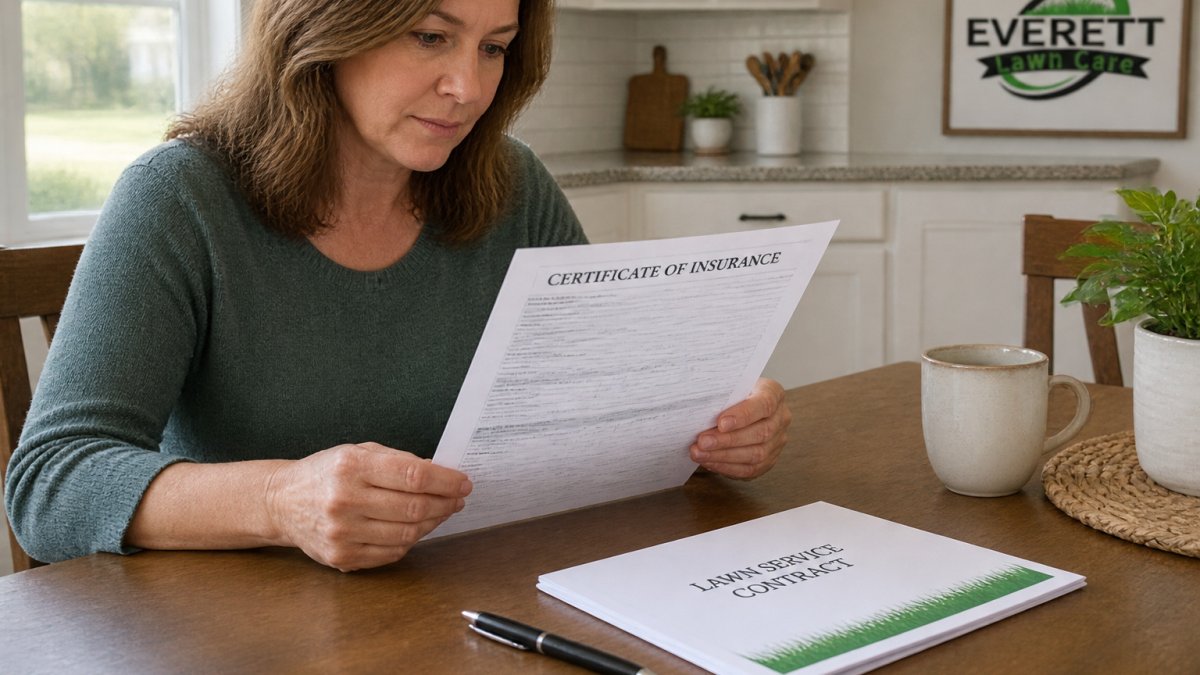
Look for these details on the certificate of insurance for lawn care contractors:
- Policy dates: The coverage should be active today, not expired. Check the effective and expiration dates against the date work begins and the length of your contract.
- Limits: Check the per-occurrence and aggregate amounts, which are usually listed in USD. Per-occurrence is the most the policy pays for any one claim; the aggregate is the most it pays for all claims during the policy period.
- Insured name: The name should match the company you are hiring, including any "doing business as" name on your contract.
- Certificate holder: You should be listed as the certificate holder, and if you requested it, as an additional insured.
- Endorsements: Look for notations such as additional insured, waiver of subrogation, or primary and non-contributory wording. These are the items most often promised verbally and left off the certificate.
- Insurer and agent contact: A legitimate certificate names the carrier and the issuing agent, which lets you call to confirm the policy is in force.
Setting limits is a judgment call, not a fixed number. Setting limits is a judgment call rather than a fixed number. Ask the company what limits it carries and why, then compare that to the value of the property and the risk of the work.
A COI that lists the wrong company name, expired dates, or missing endorsements is a warning sign. Ask for an updated certificate before the work begins. Your insurance agent can also help you read unfamiliar terms and confirm whether the endorsements you requested actually appear.
Watch out: a certificate can be issued before an endorsement is actually added to the policy, so confirm additional insured and waiver of subrogation status directly with the insurer or agent rather than relying on the certificate alone.
The certificate shows what to check, and the table below lists the key details and what each one tells you.
| Detail | What to check | Why it matters |
|---|---|---|
| Policy dates | Active today, not expired | Coverage must be in force during the work |
| Limits | Per-occurrence and aggregate, in USD | Per-occurrence caps one claim; aggregate caps all claims |
| Insured name | Matches the company you hire | Confirms the right business is covered |
| Certificate holder | You are listed | Shows you are entitled to a copy |
| Endorsements | Additional insured, waiver of subrogation | Often promised verbally but left off |
| Insurer and agent | Named on the certificate | Lets you confirm the policy is in force |
Liability and the Lawn Care Contract Indemnification Clause
The indemnification clause is where liability is assigned. Bonding requirements often appear alongside these terms, so it helps to understand them too. In plain terms, it says the company agrees to cover certain claims that arise from its work. Read it closely, because the wording controls how far that promise goes.
A strong indemnification clause usually covers:
- Injuries caused by the company's employees or equipment
- Property damage caused by crew negligence
- Legal fees tied to a covered claim
Watch for language that shifts too much risk onto you, such as clauses that make you responsible for the company's own mistakes. Some contracts also contain a hold harmless provision, which can limit what you can recover. If the wording is hard to follow, have a local attorney review it before you sign.
Watch out: a clause that says "to the extent permitted by law" can narrow the protection significantly. Ask what it means for your specific situation.
What Lawn Care Business Insurance Cost Typically Covers
Insurance cost is a normal part of running a lawn care business, and it is reflected in service pricing. What matters to you as a client is what that coverage actually protects. A policy that costs more usually means higher limits, broader protection, or coverage for more types of work.
Pricing depends on factors like the company's size, its equipment, the services offered, and its claims history. For current pricing, visit the Everett Lawn Care website or request a quote, and review the limits on your own certificate directly.
Coverage commonly carried by lawn care businesses includes general liability for property damage and injuries, workers' compensation for employees, and equipment and commercial vehicle coverage. Confirm what Everett Lawn Care carries on its certificate.
Ask whether the policy covers chemical application, which is sometimes a separate endorsement for treatments.
Workers' Compensation, Subcontractors, and Additional Insured Status
Workers' compensation protects a crew member who is hurt on the job. Without it, an injury on your property could lead to a claim against you. Ask the company to confirm in writing that all workers are covered, including anyone who is a subcontractor, and check that the workers' compensation policy appears on the certificate with active dates.
Subcontractors are a common gap. If a company hires an outside crew, that crew should carry its own general liability and workers' compensation. Otherwise the uninsured subcontractor's injury may fall back on the company, and possibly on you. Request a separate certificate for each subcontractor and confirm the coverage is active for the dates they will be on your property.
Additional insured status means you are named on the company's policy for claims arising from their work. This can give you direct access to the company's coverage if a claim comes up on your property. It is granted by an endorsement, not by the certificate itself, so ask for the endorsement and confirm it appears on the certificate.
Waiver of subrogation is a separate endorsement. It prevents the company's insurer from paying a claim and then pursuing you to recover the money. It is commonly requested alongside additional insured status, especially when your own policy might otherwise be asked to respond first. Confirm both endorsements with an insurance professional, because wording and availability vary by carrier and by state.
Watch out: a general liability policy alone does not cover employee injuries, and a certificate that shows only general liability may leave the workers' compensation and subcontractor exposure unaddressed.
Handling Claims and Documenting Incidents on the Job
Even with good coverage, things go wrong. Documentation is what makes a claim easier to resolve.
Take these steps if damage or an injury happens:
- Take photos and video of the damage before anything is moved or repaired.
- Write down the date, time, and what the crew was doing.
- Get names and contact details for every person involved.
- Notify the company in writing as soon as possible.
- Keep copies of all emails, invoices, and insurance paperwork.
A common mistake is waiting days to report damage. Prompt, written notice protects you and speeds up the claim.
Verifying Coverage Before You Sign With Everett Lawn Care
Before you sign any lawn care contract, verify the insurance in writing. Use this licensed and insured checklist to confirm each item. A reputable company will expect these questions and provide answers without hesitation.
Request these items from any provider, including Everett Lawn Care:
- A current certificate of insurance
- Confirmation of general liability and workers' compensation limits
- Written confirmation that you are named as an additional insured
- A copy of the indemnification clause in your contract
Once you have the paperwork, check the dates, limits, and names against your contract. If anything does not match, ask for a correction before work begins.
To discuss services or request a quote, visit our lawn maintenance page or review our lawn treatments options. Our team can walk you through the coverage details for your property and answer your questions in plain language.
Frequently Asked Questions
What insurance should a lawn care company have?
At minimum, a lawn care company should carry general liability insurance to cover bodily injury and property damage caused by its work, plus workers' compensation if it has employees. Many clients also expect commercial auto coverage for crew vehicles and mowers transported on trailers. Ask for a current certificate of insurance listing coverage limits and policy dates, and confirm the policies are active before the first service visit. Requirements vary by state, so check with a licensed insurance agent for North Carolina-specific obligations.
Should a lawn care contractor provide a certificate of insurance?
Yes. A certificate of insurance is the standard way for a contractor to prove coverage without sending full policy documents. It should show the insurer, policy numbers, effective dates, and per-occurrence and aggregate limits. Homeowners and property managers should request it before work begins and can ask that the client be listed as a certificate holder or additional insured. A certificate is evidence of coverage at one point in time, so request an updated one at each renewal.
Does a lawn care contract need an indemnification clause?
An indemnification clause is useful because it spells out who pays if a third party is injured or property is damaged during service. It typically requires the contractor to cover claims arising from its negligence. Read the wording carefully: broad indemnity language can shift risk onto the contractor in ways its insurance may not cover, while a clause that is too narrow may leave the client exposed. Have the clause reviewed by an attorney if the property or contract value is significant.
How much does lawn care business insurance cost?
Insurance premiums for lawn care businesses depend on factors such as annual payroll, revenue, number of vehicles, equipment types, claims history, and selected coverage limits. Because pricing varies widely, the most reliable step is to request quotes from a licensed agent who understands landscaping risks. For current pricing on Everett Lawn Care services, visit the company website or request a free estimate.
