Last Updated: November 5, 2026
Quick Summary
Choose premier commercial lawn care by comparing written scopes, not single prices. Require each bidder to state visit frequency, turf care, trimming and edging, insurance, and exclusions in writing so proposals are comparable. Verify licensing and insurance separately, and confirm crews can work within your property's operating hours.
- Weekly mowing during the growing season keeps turf healthy and prevents scalping.
- Reviews from the last year best reflect current crews and management.
- Ask bidders to state visits per month by season, not just weekly.
- Require a certificate of insurance showing current general liability coverage.
- Put the preferred service window in the contract and confirm staffing.
Table of Contents
- What Premier Commercial Lawn Care Actually Covers
- Reading Commercial Lawn Care Reviews Without Getting Fooled
- What Drives Commercial Lawn Maintenance Cost
- The Commercial Lawn Care Service Checklist to Send Every Bidder
- What Belongs in a Commercial Lawn Care Contract
- Insurance, Licensing, and Risk on a Commercial Site
- Matching a Maintenance Plan to Your Property Type
- Request a Free Estimate for Your Property
- Frequently Asked Questions
What Premier Commercial Lawn Care Actually Covers
Commercial lawn care is the scheduled maintenance of turf, beds, and grounds on business properties, delivered by insured crews under a written scope of work.
That distinction matters more than most property managers expect. A crew that only cuts grass leaves you managing weeds, compaction, and cleanup on your own.
Mowing, Trimming, and Edging on a Fixed Schedule
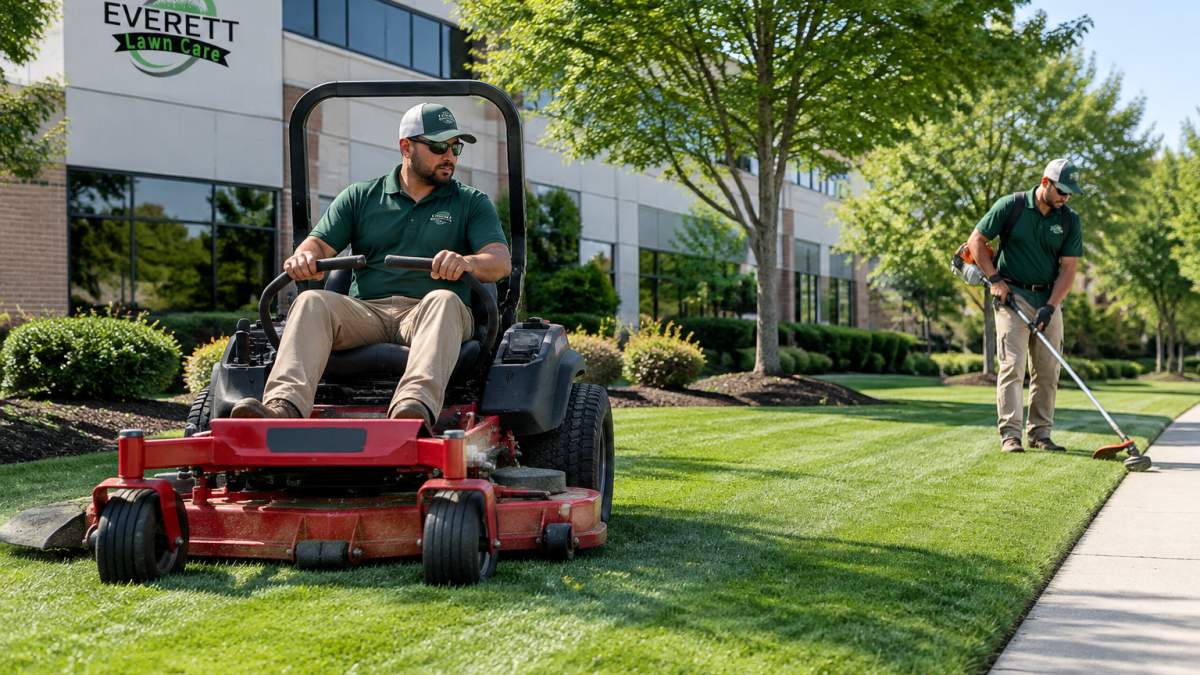
Frequency drives quality here. Weekly mowing during the growing season keeps turf at a healthy height and prevents the scalping that comes from cutting too much at once. Trimming and edging along walks, curbs, and building lines is what separates a finished property from a rough one. Ask any bidder how they handle rain delays and holiday weeks, because dependable scheduling is where contracts often break down.
Turf Care, Weed Control, and Seasonal Cleanups
Mowing alone will not fix thin turf or a broadleaf weed problem. A complete plan can add fertilization, weed control, and aeration on a calendar built for the local climate. Seasonal cleanups handle leaves, bed refresh, and pruning before and after the growing season. If you want the deeper detail on how professional weed programs work, our guide to weed control for lawns in Raleigh walks through it.
Reading Commercial Lawn Care Reviews Without Getting Fooled
Reviews tell you what a company does well and what it hides, but only if you read them correctly. Look for patterns across many reviews rather than one glowing or angry post. A firm with consistent comments about clear communication and reliable crews is usually a safe bet. A firm with repeated notes about missed visits or unreturned calls is telling you something.
Three filters help:
- Recency: Reviews from the last year reflect current crews and management.
- Specificity: "They edged the beds and cleaned up every visit" beats "great service."
- Property type: A provider praised by homeowners may have no experience with industrial properties or office complexes.
Customer ratings matter, but they are not proof of insurance, licensing, or commercial capacity. Verify those separately.
What Drives Commercial Lawn Maintenance Cost
Commercial lawn maintenance cost depends on acreage, terrain, service frequency, and how much detail the site demands. A flat half-acre office lawn and a wooded, sloped bank property take very different equipment and time.
Most commercial bids are built from four inputs, and knowing them lets you compare proposals line by line instead of staring at a single monthly number:
- Measured production time: acreage, mowing height, and how many obstacles (trees, islands, light poles, bollards) slow a zero-turn mower. A site with 40 trees and 12 bed islands takes materially longer than an open field of the same size.
- Visit frequency and season length: weekly in-season service plus a defined off-season schedule. Ask bidders to state the number of visits per month by season, not just "weekly."
- Scope inclusions: trimming, edging, blowing of all hard surfaces, bed weeding, mulch refresh, pruning, irrigation checks, and seasonal cleanups.
- Site access and constraints: gate codes, parking restrictions, loading-dock traffic, school hours, and bank-drive-through hours all change when and how fast a crew can work.
Other cost drivers include bed square footage and mulch volume, the number of trees and shrubs needing pruning, irrigation checks and water management, seasonal cleanup scope, and access, parking, and gate restrictions that slow crews.
What a Commercial Quote Should Spell Out
A commercial quote is not a single price, it is a scope document with a number attached. Require these items in writing so bids are comparable:
- Unit basis: monthly rate, per-visit rate, or annual contract with monthly billing.
- Contract length and renewal: Confirm the notice period for non-renewal.
- Billing schedule: invoice date, payment terms (net 15 or net 30 are common), and whether turf care and cleanups are bundled or billed as separate line items.
- Escalation and change orders: how price changes are handled mid-term and what triggers a change order (added acreage, new beds, storm cleanup).
- What is excluded: snow removal, irrigation repair, tree work above a certain height, and hardscape repair are frequently excluded, get the exclusions in writing.
For a benchmark on what local pricing looks like, our lawn care cost guide for Raleigh breaks down the figures property managers actually see. Watch out: a quote that lists one lump sum with no visit count, no scope detail, and no exclusions is not a bid you can compare, it is a number you will end up renegotiating mid-season.
The Commercial Lawn Care Service Checklist to Send Every Bidder
A commercial lawn care service checklist turns vague proposals into comparable bids. Send the same list to every provider and require written answers.
- Are you licensed and insured, and can you provide a certificate of insurance?
- How many crews serve our area, and who is our point of contact?
- What is the mowing frequency during peak and off season?
- Do you include trimming, edging, and blowing of all hard surfaces?
- What turf care, fertilization, and weed control are included?
- How do you handle rain delays and makeup visits?
- What is your response time for a complaint or call-back?
- Can you provide references from similar commercial sites?
What Belongs in a Commercial Lawn Care Contract
A commercial lawn care contract should state the scope, schedule, term, and price in writing, with clear terms for changes and termination. Verbal agreements create disputes over what was included. The contract is also where you lock in measurable performance standards.
Include these elements:
- Scope of work: every task, from mowing height to bed weeding
- Service schedule: frequency by month or season
- Term and renewal: start date, end date, auto-renewal terms
- Pricing and payment: monthly rate, invoicing, late terms
- Performance standards: what "complete" looks like per visit
- Insurance and indemnification: proof of coverage and liability terms
- Termination: notice period and exit conditions
A service-level agreement with measurable standards gives you something to enforce. Without it, "high-quality work" is just a phrase in a brochure.
Insurance, Licensing, and Risk on a Commercial Site
Insurance and licensing are the two credentials that protect you when something goes wrong on a commercial site. A mower can throw a stone through a window. A trimmer can nick a fence or a parked car. An uninsured crew leaves you absorbing that loss.
Ask for a certificate of insurance showing general liability coverage, and confirm the policy is current. Our guide on licensing and insurance for lawn care services explains how to check a contractor's credentials before you sign.
Matching a Maintenance Plan to Your Property Type
Property type determines the plan. An office complex with heavy foot traffic needs crisp edges and clean walks before tenants arrive. A bank or restaurant cares about curb appeal at the entrance. Schools need work scheduled around student hours. Industrial properties often need larger acreage handled efficiently plus brush and perimeter control.
The differences that actually drive the plan are operational, not cosmetic. The table below shows how common service needs vary by property type:
| Property Type | Typical Focus | Service Frequency | Key Operational Constraint |
|---|---|---|---|
| Office and retail | Appearance, entrance beds, walkways | Weekly in season | Crew must finish before tenant arrival; loading-dock and customer parking restrict equipment access |
| Banks and restaurants | Curb appeal, detail work at entrance and drive-through | Weekly in season | Drive-through lanes and ATM areas must stay clear; work often scheduled before opening |
| Schools and campuses | Safety, scheduling around hours | Weekly, adjusted for breaks | Athletic fields, playgrounds, and bus loops require coordination with facility staff; summer breaks allow larger projects |
| Industrial and wooded | Acreage, perimeter, brush control | Weekly or biweekly | Large open areas favor wide-deck mowers; perimeter and fence-line brush needs separate equipment and a defined scope |
| Medical and professional offices | Entrance detail, clean walks, low-noise visits | Weekly in season | Patient traffic and quiet expectations push visits to early morning or after hours |
High-Traffic Zones and Access Planning
On commercial sites, the highest-visibility areas are also the highest-risk areas. Entrance walks, drive-through lanes, ATM pads, and loading zones need trimming and blowing on every visit, and they need it completed before the property opens.
Access planning is where bids diverge. A site with one gate code, a shared dumpster pad, and limited trailer parking takes longer to service than an open lot. Confirm in the proposal how the crew enters, where equipment is staged, and how the provider handles locked gates or changed codes.
Scheduling Around Business Hours
A maintenance plan that ignores operating hours creates friction. Restaurants and banks often want work completed before opening; schools need work outside arrival and dismissal windows; medical offices prefer low-noise visits. Put the preferred service window in the contract and confirm the provider can staff it, not just agree to it verbally.
Common property categories include:
| Property Type | Typical Focus | Service Frequency |
|---|---|---|
| Office and retail | Appearance, entrance beds, walkways | Weekly in season |
| Banks and restaurants | Curb appeal, detail work | Weekly in season |
| Schools and campuses | Safety, scheduling around hours | Weekly, adjusted for breaks |
| Industrial and wooded | Acreage, perimeter, brush control | Weekly or biweekly |
Residential grounds and HOA common areas follow a similar logic but with more attention to bed detail. If you are comparing providers and want to see the full range of professional landscaping services available, that page outlines the options.
Request a Free Estimate for Your Property
The fastest way to know what premier lawn maintenance will cost for your site is a walkthrough with a provider who services commercial properties. Bring your checklist, ask about insurance and scheduling, and get the scope in writing. Everett Lawn Care is licensed and insured, serves the Triangle with a local crew, and handles maintenance, aeration, treatments, cleanups, and design under one plan. Visit our landscaping services page to see what we cover, then request a free estimate and get a written scope for your property.
Frequently Asked Questions
What should commercial lawn maintenance include?
A full commercial lawn care program covers scheduled mowing, trimming, and edging, plus turf care such as fertilization and weed control, seasonal cleanups, and shrub pruning. Ask whether aeration and soil testing are included or billed separately, because compacted clay soil common in the Triangle needs both to hold up under foot traffic. Get the scope in writing so you can compare bids line by line instead of guessing what each price includes.
How much does commercial lawn maintenance cost?
Pricing depends on lot size, mowing frequency, property type, and how much turf care is bundled in, so a single number does not apply across sites. A small bank branch and a multi-building office park carry very different labor and equipment demands. Ask each provider for a written quote broken down by service line, and ask what triggers a price adjustment mid-contract. Request a free estimate from Everett Lawn Care for a quote tailored to your property.
How often should a commercial property be mowed?
Most commercial sites run weekly mowing through the growing season, . Frequency should be written into the commercial lawn care contract along with a response time for callbacks. Ask what happens when rain pushes the schedule, since a dependable crew should tell you the new day rather than leave you guessing.
What questions should I ask before hiring a lawn care provider?
Ask for proof of licensing and insurance, a sample commercial lawn care contract, references from properties similar to yours, and the name of the crew lead who will actually be on site. Confirm how they handle weed control and seasonal cleanups, and whether soil testing or aeration is part of the plan.
Ready to stop chasing crews and start getting consistent results? Get started with Everett Lawn Care and put a dependable, licensed, and insured team on your grounds.
