Last Updated: November 10, 2026
Quick Summary
You can identify lawn fungus by mapping the shape of the damage, pulling blades from the edge of a bad patch to check for spots, powdery dust, or a water-soaked look, and checking soil, roots, and watering habits. Fungal damage often forms circles, rings, or irregular patches that spread outward, unlike damage from sprinklers or pets that stays in one fixed area.
- A three-step field check takes about fifteen minutes and starts with photographing and mapping the damage.
- Pull blades from the edge of a bad patch, not the dead center, and hold them against white paper in good light.
- Watering in the evening keeps blades wet overnight and may feed the problem, so water early in the day.
- Water a stressed spot well and wait five days: stress damage improves while fungal disease keeps spreading.
- Call a pro when patches keep spreading after two weeks of corrected watering or you cannot tell fungus from pest damage.
Table of Contents
- Start With a Step-by-Step Field Diagnosis
- Signs of Lawn Fungus You Can See From the Driveway
- Fungus or Something Else? Telling Lookalikes Apart
- Your Lawn Disease Identification Chart, Symptom by Symptom
- How Weather, Moisture, and Grass Type Drive Disease
- How to Treat Lawn Fungus: Decision Criteria Before You Spray
- When to Get a Professional Diagnosis and Treatment Plan
- Frequently Asked Questions
Start With a Step-by-Step Field Diagnosis
Learning how to identify lawn fungus starts with a slow, methodical walk across your yard, not a spray bottle. Fungal disease leaves patterns you can trace. Damage from heat, drought, or pests leaves different ones.
A three-step check like this is one way to read a lawn before treating it. It takes about fifteen minutes. Here is how to do it yourself.
Step 1: Map the Damage Before You Touch Anything
Grab your phone and take photos from several angles. Note the shape of the bad spots. Fungal damage often forms circles, rings, or irregular patches that spread outward. Damage from a sprinkler head or a dog tends to stay in one fixed area.
Write down three things:
- The size of each patch
- Whether the edges are sharp or fuzzy
- Where the spots sit relative to shade, slopes, and sprinklers
This map becomes your baseline. Without it, you cannot tell whether a treatment worked.
Step 2: Pull a Blade and Read It Up Close
Pluck a few grass blades from the edge of a bad patch, not the dead center. Hold them against a white sheet of paper in good light. Look for spots, stripes, powdery dust, or a water-soaked look.
Healthy blades are uniform in color. Diseased blades show lesions, rings, or a fuzzy coating. This single step separates most lawn fungus problems from simple stress.
Step 3: Check the Soil, Roots, and Watering Pattern
Push a screwdriver into the soil. If it fights you, the ground is compacted or dry. Pull up a small square of turf and look at the roots. Healthy roots are white and deep.
Then check your irrigation schedule. Fungus loves wet blades that stay wet overnight. For clay-heavy yards, our guide on clay soil lawn care fixes covers drainage in more depth.
Signs of Lawn Fungus You Can See From the Driveway
Most lawn fungus announces itself before you kneel down. Stand at the curb and scan for these signs of lawn fungus:
- Brown or yellow patches that grow larger week by week
- Circular spots or rings with greener grass in the middle
- A powdery white or gray coating on the blades
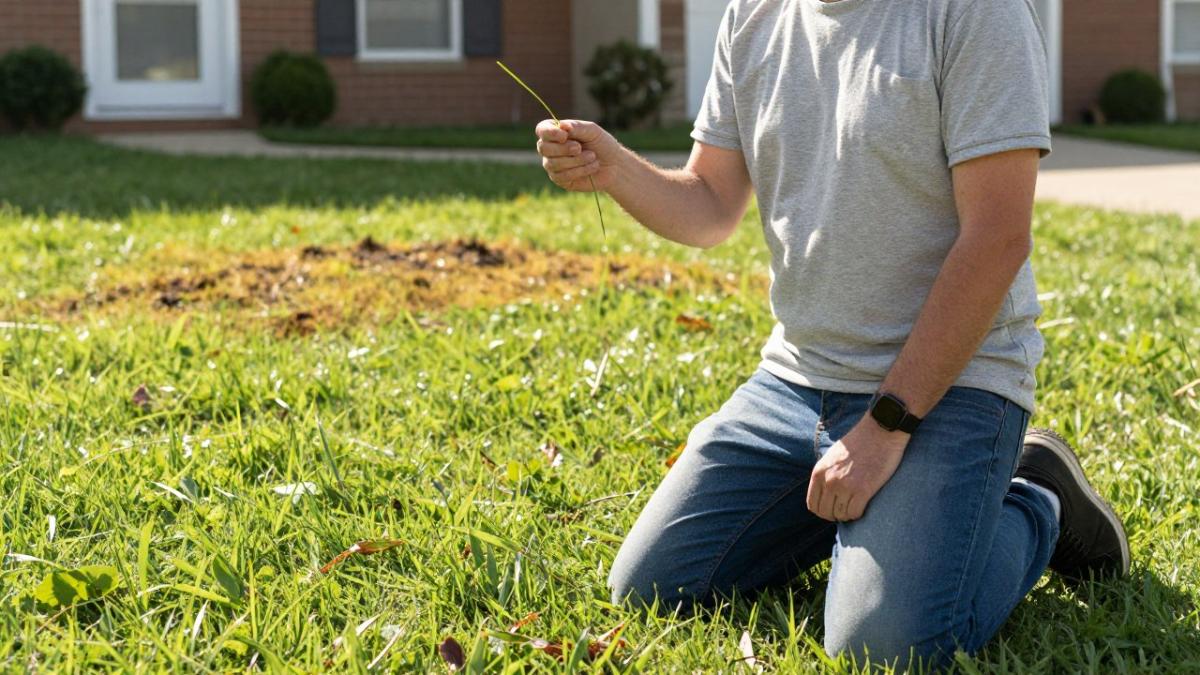
One patch can fool you. A pattern of patches tells the real story. If the damage keeps spreading despite normal watering, that is your cue to dig deeper. Our detailed guide on treating brown patches and stopping the spread walks through what to do next.
Fungus or Something Else? Telling Lookalikes Apart
Half the "fungus" calls we get turn out to be something else. Before you spend money on treatment, rule out the usual suspects. The key is to compare not just what the damage looks like, but how it behaves over time and where it sits in the yard.
Drought and Heat Stress
Drought damage shows up as crispy, straw-colored grass in the hottest, sunniest spots. It often follows the shape of your yard, not a circle, and it hits thin, exposed turf first.
Watch out: watering a drought-stressed lawn in the evening to "catch up" can create the exact wet-blade conditions that invite fungus, so water early in the day and water deeply but less often.
Insects, Grubs, and Pet Damage
Grubs chew roots, so the turf lifts up like a loose carpet. Pull back a square of turf at the edge of a dead patch and check the top two inches of soil for white, C-shaped grubs. Pet urine leaves bright green centers ringed by dead grass, and the pattern tends to follow a dog's regular route rather than a circle.
Mowing and Fertilizer Burn
A dull mower blade shreds grass tips, leaving a frayed, tan cast across the whole lawn rather than distinct patches. Fertilizer burn shows up as streaked or speckled browning that follows the spreader pattern, often with crisp edges and a uniform burn line. Neither is fungal, and both resolve as the grass grows out.
Thatch and Soil Problems
A thick thatch layer over half an inch holds moisture against the soil and can mimic fungal patches by keeping the canopy wet. Push a screwdriver into the soil: if it fights you, compaction or dry soil is limiting roots, and the browning is a symptom of poor rooting rather than disease.
A Quick Side-by-Side Comparison
| Lookalike | What You See | How It Behaves | Quick Field Test |
|---|---|---|---|
| Drought/heat stress | Straw-colored, crispy turf in sunny spots | Improves with deep watering in 1-2 weeks | Water and recheck in five days |
| Grubs | Turf lifts like carpet, spongy feel | Spreads slowly, roots chewed | Pull back turf, look for white grubs |
| Pet damage | Green center ringed by dead grass | Follows dog's route, fixed location | Note pattern and location |
| Mower damage | Frayed, tan tips across lawn | Uniform, not patchy | Inspect blade sharpness |
| Fertilizer burn | Streaked or speckled browning | Follows spreader pattern | Review application pattern |
| Thatch buildup | Spongy surface, wet canopy | Patches persist despite watering | Measure thatch depth |
If the damage keeps spreading despite corrected watering and the pattern is circular or ring-shaped, that is your cue to dig deeper into fungal causes. Our detailed guide on treating brown patches and stopping the spread walks through what to do next.
Your Lawn Disease Identification Chart, Symptom by Symptom
Use this lawn disease identification chart as a quick field reference. Match the symptom first, then confirm with a close look at the blades and the pattern of the patch. The chart below adds grass-species notes and a visual decision path so you can narrow the field before you spend money on treatment.
Symptom-Based Decision Guide
Start with the shape of the damage. Circular rings or arcs point toward fairy ring or necrotic ring spot. Irregular, spreading patches in summer heat point toward summer patch or brown patch. A powdery coating on the blades points toward powdery mildew. Matted, gray or pink fuzzy growth after snowmelt points toward snow mold. Small lesions on individual blades point toward leaf spots.
Disease Identification Chart
| Symptom | Likely Cause | Grass Types Most Affected | Where It Shows Up | Quick Check |
|---|---|---|---|---|
| Circular brown rings with green centers | Fairy ring or necrotic ring spot | Kentucky bluegrass, fine fescue | Sandy soil, thatch buildup | Ring shape stays fixed |
| White powdery coating on blades | Powdery mildew | Kentucky bluegrass, shade-stressed turf | Shady, humid areas | Wipes off on your finger |
| Gray or pink fuzzy growth | Snow mold | All cool-season grasses | After winter cover melts | Patches matted together |
| Irregular dead patches in summer heat | Summer patch | Kentucky bluegrass, annual bluegrass | Full sun, compacted soil | Roots brown and shallow |
| Yellow patches spreading fast | Leaf spots | Most turfgrasses | Wet, humid weather | Small lesions on blades |
| Large irregular brown patches with smoky edges | Brown patch | Tall fescue, perennial ryegrass | Hot, humid nights | Lesions on blades, spreading outward |
Grass-Species Notes
Cool-season grasses like tall fescue and Kentucky bluegrass are most vulnerable to brown patch, summer patch, and powdery mildew during hot, humid summers. Warm-season grasses like bermudagrass and zoysiagrass have their own weak points, including large patch and spring dead spot. Knowing your grass type narrows the likely disease before you even kneel down.
When to Confirm With a Lab
A chart narrows the field, but some diseases look nearly identical without a microscope. If symptoms are ambiguous, if patches keep spreading after two weeks of corrected watering, or if you need to confirm before applying an expensive fungicide, collect a sample: cut a 4-inch square of turf at the edge of the damaged area, include the roots and about an inch of soil, keep it moist, and submit it to your state's university extension plant diagnostic lab.
Print this chart or save it on your phone. It narrows the field fast, and paired with the lookalike comparison above, it keeps you from spraying the wrong product on the wrong problem.
How Weather, Moisture, and Grass Type Drive Disease
Fungal disease needs three things: moisture, the right temperature, and a susceptible grass. Take away any one and the fungus stalls.
Humidity and long leaf wetness are the biggest drivers. Grass that stays wet for hours after sunrise is a breeding ground.
Grass type matters too. Seasonal timing matters as much as species, which is why our guide on when to fertilize fescue pairs feeding schedules with disease risk.
The turfgrass disease management guidance from university extension programs is a solid reference for how weather patterns drive outbreaks.
How to Treat Lawn Fungus: Decision Criteria Before You Spray
Fungicide is not a first move. It is a last step, and only after you have confirmed the problem. Here is how we decide whether to spray:
- Confirm the diagnosis. A wrong diagnosis wastes money and can harm the lawn.
- Fix the water first. Adjust your irrigation to early morning and cut back frequency.
- Reduce thatch. Thick thatch holds moisture against the soil.
- Improve airflow. Trim low branches and thin dense shade.
- Spray only if the disease is spreading. Choose a product labeled for that specific disease.
Watch out: spraying a fungicide on drought or grub damage does nothing except cost you money.
If the damage has already killed grass down to bare soil, treatment and repair are two separate jobs. Our guide on repairing bare lawn patches covers the recovery side.
When to Get a Professional Diagnosis and Treatment Plan
Some problems outrun a homeowner's toolkit.
A professional brings soil testing, the right product for the specific disease, and a plan that fits your grass type and yard layout.
That is the difference between guessing and fixing it for good. For a professional diagnosis and treatment plan, explore our Raleigh landscaping services and see how we handle fungus, soil, and recovery in one visit.
Fungus rarely fixes itself, and the wrong treatment makes it worse. Get a real diagnosis first, then act.
Frequently Asked Questions
How can I tell lawn fungus apart from heat or drought stress?
Drought stress usually shows up as a uniform dull gray-green cast across the whole lawn, and footprints stay visible in the turf long after you walk across it. Fungus tends to appear in defined patches, rings, or streaks, and the blades themselves carry spots, lesions, or powdery growth. Water a stressed patch deeply and watch it for a few days: drought damage recovers, while fungal damage keeps spreading, especially in humid weather.
Can lawn fungus spread from one yard to another when mowing?
Yes. Mower blades and tires pick up clippings carrying fungal spores and drop them on the next lawn, which is one reason lawn care crews wash equipment between properties. If you mow your own lawn, cut the affected area last and rinse the deck afterward. Bagging clippings from an active outbreak also reduces the amount of infected material sitting on the surface.
Can you ever get rid of lawn fungus completely?
Fungal spores are always present in soil, so the realistic goal is management rather than elimination. Most outbreaks settle down once weather dries out and air circulation improves. Long-term control comes from the basics: watering deeply but infrequently in the morning, mowing at the right height, aerating compacted soil, and correcting drainage. A fungicide can stop an active outbreak, but it will not fix the conditions that caused it.
When should I treat lawn fungus myself and when should I call a professional?
Small patches, a few inches across, often clear up with better watering and mowing habits alone. Call a professional when patches keep expanding despite your adjustments, when the same spot flares up every season, or when damage covers a large share of the lawn. A pro can run soil tests, confirm the disease, and build a treatment and aeration plan matched to your grass type.
