Everett Lawn Care LLC

Lawn mowing and treatments in the Raleigh area

Everett Lawn Care offers recurring mowing, fertilization, and weed control in Raleigh and nearby communities. Request an estimate for either service or both.

Serving Raleigh, Cary, Apex, Holly Springs, Wake Forest, and nearby Triangle cities.

We also do cleanups, sod, and mulch

  • Seasonal cleanups Clear fallen leaves and yard debris and tidy up outdoor areas between seasons.
  • Sod installation Install new turf in bare or damaged areas, or replace a lawn that needs a fresh start.
  • Mulch installation Refresh planting beds with mulch or ask about gravel for paths and other areas.

Request an estimate · Contact us · (919) 899-2341 · info@everett-lawncare.com

5300 Six Forks Rd, Raleigh, NC 27609

How to Treat Brown Patches in Lawn and Stop Them Spreading

By Everett McLain

Last Updated: November 8, 2026

Quick Summary

Treat brown patches by first confirming the cause, since fungus, drought, grubs and spills each need a different fix. For brown patch fungus, apply fungicide and change watering so blades dry by mid-day, then rake out dead grass and reseed once the patch stops spreading for at least seven days.

  • Brown patch shows a frog-eye ring of dead grass around a green center and spreads when leaves stay wet over 10 hours.
  • Grass that lifts easily at the patch edge points to grubs or root rot, while firm grass suggests water or fungus.
  • Water early morning, water deep and less often, raise the mower deck, and bag clippings during an outbreak.
  • Seed tall fescue at about 6 to 8 pounds per 1,000 square feet and expect germination in 7 to 14 days.
  • Call a pro if patches keep spreading after two weeks of home treatment or return every season.
Not sure what is causing your brown patches?We diagnose the cause, test your soil, and build a treatment plan for your lawn.
Get a Free Estimate

Table of Contents

Read the Patch Before You Treat It

Brown patches rarely mean one single problem. A dry spot, a fungal disease, and grub damage can all look like dead grass from standing height. Treating the wrong cause wastes money and lets the real problem spread.

A common mistake in Triangle yards is spraying a fungicide on a patch that is actually drought stress, or watering a fungus into a bigger outbreak. The fix starts with reading the patch itself.

Below, we walk through how to tell them apart, how to treat each one, and when to call in a professional.

Common Causes of Brown Spots in Grass

The causes of brown spots in grass fall into four main groups: fungus, drought, insects, and spills. Each one leaves a different signature on the lawn, and the fastest way to waste money is to treat the wrong one. Below is how to tell them apart with concrete field criteria, plus a decision sequence you can run in about 15 minutes.
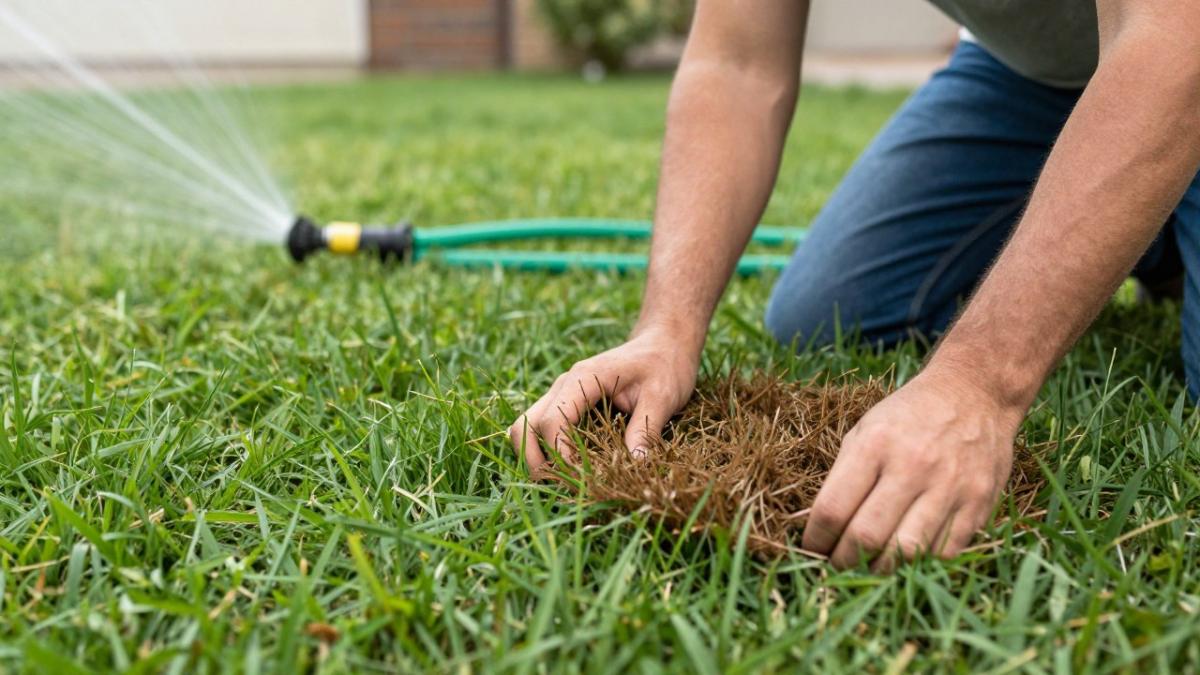
Homeowner kneeling on a lawn inspecting brown patches next to healthy grass with a garden hose nearby

Fungus, Drought, Grubs, and Spills: Telling Them Apart

Fungus usually appears as circular patches that grow outward, often with a darker or water-soaked edge visible early in the morning.

Drought stress shows up as irregular browning, often near pavement, on slopes, or on high spots where water runs off.

Grubs chew roots below the surface. The patch feels spongy and lifts like loose carpet.

Spills from fertilizer, gasoline, or pool water leave sharp-edged dead zones.

A quick test helps. Pull a handful of grass at the edge of the patch. If it lifts with almost no resistance, suspect grubs or root rot.

A Decision Sequence for Diagnosing Brown Patches

Working through the causes in a fixed order helps prevent the common mistake of spraying before confirming the problem. Use this sequence:

  1. Check the shape and edge. Sharp, straight edges suggest a spill. Circular or irregular edges suggest fungus or drought. A ring with a green center strongly suggests brown patch fungus.
  2. Run the tug test. Grass that lifts easily means root damage, grubs or root rot. Grass that holds firm means the problem is above ground or water-related.
  3. Check soil moisture. Push a screwdriver into the soil at the patch edge. If it goes in easily, water is not the issue. If it resists, drought or compaction is likely.
  4. Look for activity at night. Skunks and birds digging in the patch point to grubs. Earthworm castings are harmless and should not be confused with grub damage.
  5. Review recent history. A fertilizer or gasoline spill, a pool backwash, or a change in irrigation schedule often explains a sharp-edged or sudden patch.

Watch out: applying fungicide to a drought patch does nothing and can stress the grass further, while watering a grub infestation makes the turf spongier and easier for animals to tear up. Confirm the cause before you buy any product.

Cause Shape and Edge Tug Test Soil Moisture Night Activity
Fungus (brown patch) Circular, frog-eye ring, dark morning edge Lifts easily at edge Damp None
Drought Irregular, near pavement or high spots Holds firm Dry an inch down None
Grubs Irregular, spongy Lifts like carpet Normal to damp Skunks and birds dig
Spills Sharp, matches spill pattern Varies Varies None

Once you have a likely cause, move to the treatment section below. If two causes overlap, which happens in lawns with compacted soil and poor drainage, fix the water and soil problem first, because fungus and grubs both thrive in stressed turf.

Brown Patch Lawn Disease Treatment That Actually Works

Effective brown patch lawn disease treatment combines the right product with changes to how you water and mow. Fungicide alone will not fix a lawn that stays wet overnight.

The fungus that causes brown patch loves prolonged leaf wetness. Watering in the evening keeps blades damp for hours. That is the single biggest mistake we see.

Watering, Mowing, and Timing Changes That Starve the Fungus

  • Water early. Aim for early morning so blades dry by mid-day.
  • Water deep, not often. Fewer, longer soakings push roots down.
  • Raise the mower deck. Taller grass dries faster and shades the soil.
  • Bag clippings during an outbreak. Remove diseased material from the lawn.
  • Avoid evening irrigation. Damp overnight grass feeds the fungus.

Timing matters as much as technique. Fertilizing fescue at the wrong time of year pushes soft growth that disease attacks first. Our guide on when to fertilize fescue covers the seasonal schedule that keeps turf strong without inviting fungus.

Aerate compacted soil so water and air reach the roots. Our aeration and seeding service opens up tight clay soil so treatments work better.

How to Repair Dead Patches in Lawn Once the Cause Is Gone

Once the cause is treated, dead patches need new grass. Repair means clearing the dead material, fixing the soil, and reseeding or sodding at the right time, and the timing and rates matter more than most homeowners expect.

Start by raking out the dead grass and thatch. Loosen the top inch of soil so seed can make contact. Then apply seed suited to your grass type and keep it moist until it sprouts.

Step-by-Step Repair With Timing and Rates

  1. Confirm the cause is resolved. Do not seed into an active fungus or grub problem, new grass will die too. Wait until the patch edge stops spreading for at least seven days.
  2. Remove dead material. Rake or use a dethatching rake to pull out dead grass and thatch. Bag the debris rather than leaving it on the lawn, especially if fungus was the cause.
  3. Fix the soil. Loosen the top inch with a hard rake or core aerator. If the soil is compacted clay, core aeration before seeding improves seed-to-soil contact and root penetration.
  4. Apply seed at the right rate. Most cool-season grasses such as tall fescue are seeded at about 6 to 8 pounds per 1,000 square feet for new seedings, and slightly lower for overseeding. Warm-season grasses like bermuda and zoysia are usually sodded or plugged rather than seeded. Check the seed label for the rate for your specific variety.
  5. Cover lightly. A thin layer of straw or a peat moss topdressing, about 1/8 inch, holds moisture without smothering the seed.
  6. Water lightly and often. Keep the top inch of soil moist until germination, which for tall fescue typically takes 7 to 14 days. After germination, shift to deeper, less frequent watering.
  7. Protect the new grass. Keep foot traffic off the patch until the new grass is tall enough to mow, usually about 3 inches for tall fescue.

For a deeper walkthrough, see our guide on how to repair bare lawn patches. It covers soil prep, seeding rates, and watering schedules in detail.

Seeding vs. Sodding: Which to Choose

Seeding is cheaper and works well for small to medium patches, but it takes longer to fill in and is vulnerable to washout and birds.

Watch out: seeding tall fescue in the middle of summer usually fails because soil temperatures are too high and water demands are too great.

Do not rush this step. Seeding into an active fungus or grub problem just kills the new grass too. Once the repair is done, keep monitoring the edges of the patch for two weeks, recovery shows first at the edges, not the center.

When to Get Professional Lawn Disease Diagnosis

Call a pro when the patch keeps spreading after two weeks of home treatment, when patches return every season, or when you cannot tell the cause apart.

A professional lawn disease diagnosis starts with soil testing and a close look at the turf. Our soil testing service tells you what the lawn is actually missing before anyone sprays anything.

Cost is a fair question. Our lawn care pricing guide explains what drives the numbers before you commit.

You should also confirm the company is properly covered. Our guide on licensed and insured lawn care explains what to check before hiring anyone to treat your lawn.

A Step-by-Step Plan to Treat Brown Patches in Lawn

Here is the order we follow on every service call. Work through it in sequence rather than skipping ahead to a spray.

Total time: about 2-4 weeks from diagnosis to visible recovery. Difficulty: moderate for diagnosis, easy for follow-through.

  1. Read the patch. Check shape, edges, and root hold. [Time: 10 minutes]
  2. Rule out water and insects. Run the pull test and check for grubs. [Time: 15 minutes]
  3. Fix watering and mowing. Switch to early-morning, deep watering. [Time: ongoing]
  4. Apply the right treatment. Fungicide for disease, insect control for grubs, water for drought. [Time: 1 hour]
  5. Remove dead material. Rake out dead grass and thatch. [Time: 1-2 hours]
  6. Repair the bare spots. Loosen soil, seed, and keep moist. [Time: 1 hour]
  7. Monitor for two weeks. Watch the edges, not the center. [Time: ongoing]
Problem Telltale Sign Fix Timeline
Fungus Circular patches, dark edges Fungicide plus watering changes 2-3 weeks
Drought Straw-colored, firm roots Deep morning watering 1-2 weeks
Grubs Spongy turf, lifts easily Grub treatment 2-3 weeks
Spills Sharp-edged dead zone Remove soil, reseed 3-4 weeks

Timeline

Fungus 2-3 weeks
Drought 1-2 weeks
Grubs 2-3 weeks
Spills 3-4 weeks

Watch out: spraying fungicide on a drought patch does nothing and can stress the grass further. Confirm the cause first.

Book a Lawn Evaluation and Get a Free Estimate

Reading the patch yourself gets you part of the way. A proper diagnosis and treatment plan gets you the rest.

Our licensed and insured crew serves the Triangle area with maintenance, treatments, aeration, and design. We can help identify the cause and build a plan for your specific yard.

Get a free estimate and let us take the guesswork out of your lawn. Visit our professional landscaping in Raleigh, NC page to book a lawn evaluation.


Brown patches will keep coming back until the underlying cause is handled.

Frequently Asked Questions

What is the most common cause of brown patches in a lawn?

Brown patch lawn disease is the most frequent culprit, especially in warm, humid weather when nights stay above 68°F and grass stays wet for long stretches. Other common causes include drought stress, grub damage, fertilizer spills, and dog urine. Check whether the patch has a dark ring at the edge, which points to fungus, versus a uniform dead center, which often means drought or grubs.

How do you treat brown patches in grass?

Start by identifying the cause. For fungus, improve airflow, water deeply but less often in the early morning, and apply a fungicide labeled for brown patch if the spread continues. For drought, soak the soil 6 to 8 inches deep once a week. For grubs, confirm with a soil check before applying grub control. Once the cause is handled, rake out dead material and overseed or sod the bare spots.

Should you water brown patches in your lawn?

Yes, but timing matters. Water early in the morning so grass blades dry before evening, which reduces fungal growth. Water deeply once or twice a week rather than lightly every day. If the patch is caused by brown patch disease, evening watering makes it worse. A simple screwdriver test tells you if the soil is dry 4 inches down and actually needs water.

Can brown grass turn green again?

Dormant or drought-stressed grass can green up once water returns, usually within one to two weeks. Grass killed by fungus, grubs, or chemical spills will not recover because the crown is dead. Tug on a handful: if it pulls up easily with no roots, the grass is dead and needs reseeding or sod. If it holds firm, give it water and time before replacing it.

GoogleAdd everett-lawncare.com as a preferred source on Google →

How to Treat Brown Patches in Lawn and Stop Them Spreading

By Everett McLain

Last Updated: November 8, 2026

Quick Summary

Treat brown patches by first confirming the cause, since fungus, drought, grubs and spills each need a different fix. For brown patch fungus, apply fungicide and change watering so blades dry by mid-day, then rake out dead grass and reseed once the patch stops spreading for at least seven days.

  • Brown patch shows a frog-eye ring of dead grass around a green center and spreads when leaves stay wet over 10 hours.
  • Grass that lifts easily at the patch edge points to grubs or root rot, while firm grass suggests water or fungus.
  • Water early morning, water deep and less often, raise the mower deck, and bag clippings during an outbreak.
  • Seed tall fescue at about 6 to 8 pounds per 1,000 square feet and expect germination in 7 to 14 days.
  • Call a pro if patches keep spreading after two weeks of home treatment or return every season.
Not sure what is causing your brown patches?We diagnose the cause, test your soil, and build a treatment plan for your lawn.
Get a Free Estimate

Table of Contents

Read the Patch Before You Treat It

Brown patches rarely mean one single problem. A dry spot, a fungal disease, and grub damage can all look like dead grass from standing height. Treating the wrong cause wastes money and lets the real problem spread.

A common mistake in Triangle yards is spraying a fungicide on a patch that is actually drought stress, or watering a fungus into a bigger outbreak. The fix starts with reading the patch itself.

Below, we walk through how to tell them apart, how to treat each one, and when to call in a professional.

Common Causes of Brown Spots in Grass

The causes of brown spots in grass fall into four main groups: fungus, drought, insects, and spills. Each one leaves a different signature on the lawn, and the fastest way to waste money is to treat the wrong one. Below is how to tell them apart with concrete field criteria, plus a decision sequence you can run in about 15 minutes.

Homeowner kneeling on a lawn inspecting brown patches next to healthy grass with a garden hose nearby

Fungus, Drought, Grubs, and Spills: Telling Them Apart

Fungus usually appears as circular patches that grow outward, often with a darker or water-soaked edge visible early in the morning.

Drought stress shows up as irregular browning, often near pavement, on slopes, or on high spots where water runs off.

Grubs chew roots below the surface. The patch feels spongy and lifts like loose carpet.

Spills from fertilizer, gasoline, or pool water leave sharp-edged dead zones.

A quick test helps. Pull a handful of grass at the edge of the patch. If it lifts with almost no resistance, suspect grubs or root rot.

A Decision Sequence for Diagnosing Brown Patches

Working through the causes in a fixed order helps prevent the common mistake of spraying before confirming the problem. Use this sequence:

  1. Check the shape and edge. Sharp, straight edges suggest a spill. Circular or irregular edges suggest fungus or drought. A ring with a green center strongly suggests brown patch fungus.
  2. Run the tug test. Grass that lifts easily means root damage, grubs or root rot. Grass that holds firm means the problem is above ground or water-related.
  3. Check soil moisture. Push a screwdriver into the soil at the patch edge. If it goes in easily, water is not the issue. If it resists, drought or compaction is likely.
  4. Look for activity at night. Skunks and birds digging in the patch point to grubs. Earthworm castings are harmless and should not be confused with grub damage.
  5. Review recent history. A fertilizer or gasoline spill, a pool backwash, or a change in irrigation schedule often explains a sharp-edged or sudden patch.

Watch out: applying fungicide to a drought patch does nothing and can stress the grass further, while watering a grub infestation makes the turf spongier and easier for animals to tear up. Confirm the cause before you buy any product.

Cause Shape and Edge Tug Test Soil Moisture Night Activity
Fungus (brown patch) Circular, frog-eye ring, dark morning edge Lifts easily at edge Damp None
Drought Irregular, near pavement or high spots Holds firm Dry an inch down None
Grubs Irregular, spongy Lifts like carpet Normal to damp Skunks and birds dig
Spills Sharp, matches spill pattern Varies Varies None

Once you have a likely cause, move to the treatment section below. If two causes overlap, which happens in lawns with compacted soil and poor drainage, fix the water and soil problem first, because fungus and grubs both thrive in stressed turf.

Brown Patch Lawn Disease Treatment That Actually Works

Effective brown patch lawn disease treatment combines the right product with changes to how you water and mow. Fungicide alone will not fix a lawn that stays wet overnight.

The fungus that causes brown patch loves prolonged leaf wetness. Watering in the evening keeps blades damp for hours. That is the single biggest mistake we see.

Watering, Mowing, and Timing Changes That Starve the Fungus

  • Water early. Aim for early morning so blades dry by mid-day.
  • Water deep, not often. Fewer, longer soakings push roots down.
  • Raise the mower deck. Taller grass dries faster and shades the soil.
  • Bag clippings during an outbreak. Remove diseased material from the lawn.
  • Avoid evening irrigation. Damp overnight grass feeds the fungus.

Timing matters as much as technique. Fertilizing fescue at the wrong time of year pushes soft growth that disease attacks first. Our guide on when to fertilize fescue covers the seasonal schedule that keeps turf strong without inviting fungus.

Aerate compacted soil so water and air reach the roots. Our aeration and seeding service opens up tight clay soil so treatments work better.

How to Repair Dead Patches in Lawn Once the Cause Is Gone

Once the cause is treated, dead patches need new grass. Repair means clearing the dead material, fixing the soil, and reseeding or sodding at the right time, and the timing and rates matter more than most homeowners expect.

Start by raking out the dead grass and thatch. Loosen the top inch of soil so seed can make contact. Then apply seed suited to your grass type and keep it moist until it sprouts.

Step-by-Step Repair With Timing and Rates

  1. Confirm the cause is resolved. Do not seed into an active fungus or grub problem, new grass will die too. Wait until the patch edge stops spreading for at least seven days.
  2. Remove dead material. Rake or use a dethatching rake to pull out dead grass and thatch. Bag the debris rather than leaving it on the lawn, especially if fungus was the cause.
  3. Fix the soil. Loosen the top inch with a hard rake or core aerator. If the soil is compacted clay, core aeration before seeding improves seed-to-soil contact and root penetration.
  4. Apply seed at the right rate. Most cool-season grasses such as tall fescue are seeded at about 6 to 8 pounds per 1,000 square feet for new seedings, and slightly lower for overseeding. Warm-season grasses like bermuda and zoysia are usually sodded or plugged rather than seeded. Check the seed label for the rate for your specific variety.
  5. Cover lightly. A thin layer of straw or a peat moss topdressing, about 1/8 inch, holds moisture without smothering the seed.
  6. Water lightly and often. Keep the top inch of soil moist until germination, which for tall fescue typically takes 7 to 14 days. After germination, shift to deeper, less frequent watering.
  7. Protect the new grass. Keep foot traffic off the patch until the new grass is tall enough to mow, usually about 3 inches for tall fescue.

For a deeper walkthrough, see our guide on how to repair bare lawn patches. It covers soil prep, seeding rates, and watering schedules in detail.

Seeding vs. Sodding: Which to Choose

Seeding is cheaper and works well for small to medium patches, but it takes longer to fill in and is vulnerable to washout and birds.

Watch out: seeding tall fescue in the middle of summer usually fails because soil temperatures are too high and water demands are too great.

Do not rush this step. Seeding into an active fungus or grub problem just kills the new grass too. Once the repair is done, keep monitoring the edges of the patch for two weeks, recovery shows first at the edges, not the center.

When to Get Professional Lawn Disease Diagnosis

Call a pro when the patch keeps spreading after two weeks of home treatment, when patches return every season, or when you cannot tell the cause apart.

A professional lawn disease diagnosis starts with soil testing and a close look at the turf. Our soil testing service tells you what the lawn is actually missing before anyone sprays anything.

Cost is a fair question. Our lawn care pricing guide explains what drives the numbers before you commit.

You should also confirm the company is properly covered. Our guide on licensed and insured lawn care explains what to check before hiring anyone to treat your lawn.

A Step-by-Step Plan to Treat Brown Patches in Lawn

Here is the order we follow on every service call. Work through it in sequence rather than skipping ahead to a spray.

Total time: about 2-4 weeks from diagnosis to visible recovery. Difficulty: moderate for diagnosis, easy for follow-through.

  1. Read the patch. Check shape, edges, and root hold. [Time: 10 minutes]
  2. Rule out water and insects. Run the pull test and check for grubs. [Time: 15 minutes]
  3. Fix watering and mowing. Switch to early-morning, deep watering. [Time: ongoing]
  4. Apply the right treatment. Fungicide for disease, insect control for grubs, water for drought. [Time: 1 hour]
  5. Remove dead material. Rake out dead grass and thatch. [Time: 1-2 hours]
  6. Repair the bare spots. Loosen soil, seed, and keep moist. [Time: 1 hour]
  7. Monitor for two weeks. Watch the edges, not the center. [Time: ongoing]
Problem Telltale Sign Fix Timeline
Fungus Circular patches, dark edges Fungicide plus watering changes 2-3 weeks
Drought Straw-colored, firm roots Deep morning watering 1-2 weeks
Grubs Spongy turf, lifts easily Grub treatment 2-3 weeks
Spills Sharp-edged dead zone Remove soil, reseed 3-4 weeks

Timeline

Fungus 2-3 weeks
Drought 1-2 weeks
Grubs 2-3 weeks
Spills 3-4 weeks

Watch out: spraying fungicide on a drought patch does nothing and can stress the grass further. Confirm the cause first.

Book a Lawn Evaluation and Get a Free Estimate

Reading the patch yourself gets you part of the way. A proper diagnosis and treatment plan gets you the rest.

Our licensed and insured crew serves the Triangle area with maintenance, treatments, aeration, and design. We can help identify the cause and build a plan for your specific yard.

Get a free estimate and let us take the guesswork out of your lawn. Visit our professional landscaping in Raleigh, NC page to book a lawn evaluation.


Brown patches will keep coming back until the underlying cause is handled.

Frequently Asked Questions

What is the most common cause of brown patches in a lawn?

Brown patch lawn disease is the most frequent culprit, especially in warm, humid weather when nights stay above 68°F and grass stays wet for long stretches. Other common causes include drought stress, grub damage, fertilizer spills, and dog urine. Check whether the patch has a dark ring at the edge, which points to fungus, versus a uniform dead center, which often means drought or grubs.

How do you treat brown patches in grass?

Start by identifying the cause. For fungus, improve airflow, water deeply but less often in the early morning, and apply a fungicide labeled for brown patch if the spread continues. For drought, soak the soil 6 to 8 inches deep once a week. For grubs, confirm with a soil check before applying grub control. Once the cause is handled, rake out dead material and overseed or sod the bare spots.

Should you water brown patches in your lawn?

Yes, but timing matters. Water early in the morning so grass blades dry before evening, which reduces fungal growth. Water deeply once or twice a week rather than lightly every day. If the patch is caused by brown patch disease, evening watering makes it worse. A simple screwdriver test tells you if the soil is dry 4 inches down and actually needs water.

Can brown grass turn green again?

Dormant or drought-stressed grass can green up once water returns, usually within one to two weeks. Grass killed by fungus, grubs, or chemical spills will not recover because the crown is dead. Tug on a handful: if it pulls up easily with no roots, the grass is dead and needs reseeding or sod. If it holds firm, give it water and time before replacing it.

GoogleAdd everett-lawncare.com as a preferred source on Google →

Everett Lawn Care

Loading your experience…

Please wait — this usually finishes in a few seconds.