Everett Lawn Care LLC

Professional Landscaping in Raleigh, NC

Everett Lawn Care provides mowing, aeration, seeding, sod installation, mulch, cleanups, landscaping, and pressure washing in Raleigh and Wake County.

Serving Raleigh, Cary, Apex, Holly Springs, Wake Forest, and nearby Triangle cities.

Request an estimate · Contact us · (919) 899-2341 · info@everett-lawncare.com

5300 Six Forks Rd, Raleigh, NC 27609

Why Crabgrass Keeps Coming Back to Your Lawn

By Everett McLain

Last Updated: October 26, 2026

Quick Summary

Crabgrass keeps coming back because your soil holds thousands of dormant seeds that survive for years, even decades, waiting for the right soil temperature to germinate. A single plant produces thousands of seeds, so years of untreated infestation build a massive reserve that one year of treatment rarely solves permanently.

  • Crabgrass seeds germinate when soil temperature holds around 55-60 degrees Fahrenheit for several consecutive days, typically in spring.
  • Post-emergent herbicides kill visible crabgrass but do nothing to prevent new seeds from germinating next year.
  • Pre-emergent herbicide stops seeds from germinating but only works inside a narrow window set by soil temperature at the 2-inch depth.
  • Thin, weak turf cannot resist reinfestation; bare spots invite new seeds and crabgrass colonizes easily after treatment.
  • Breaking the cycle requires a multi-season plan: stop new additions in year one, thicken turf in year two, and monitor and spot-treat in year three.

Table of Contents

Understanding the Crabgrass Seed Bank and Why It Persists

That persistent supply is the seed bank: every plant drops seeds before dying, and they stay viable underground even after you kill every visible plant.
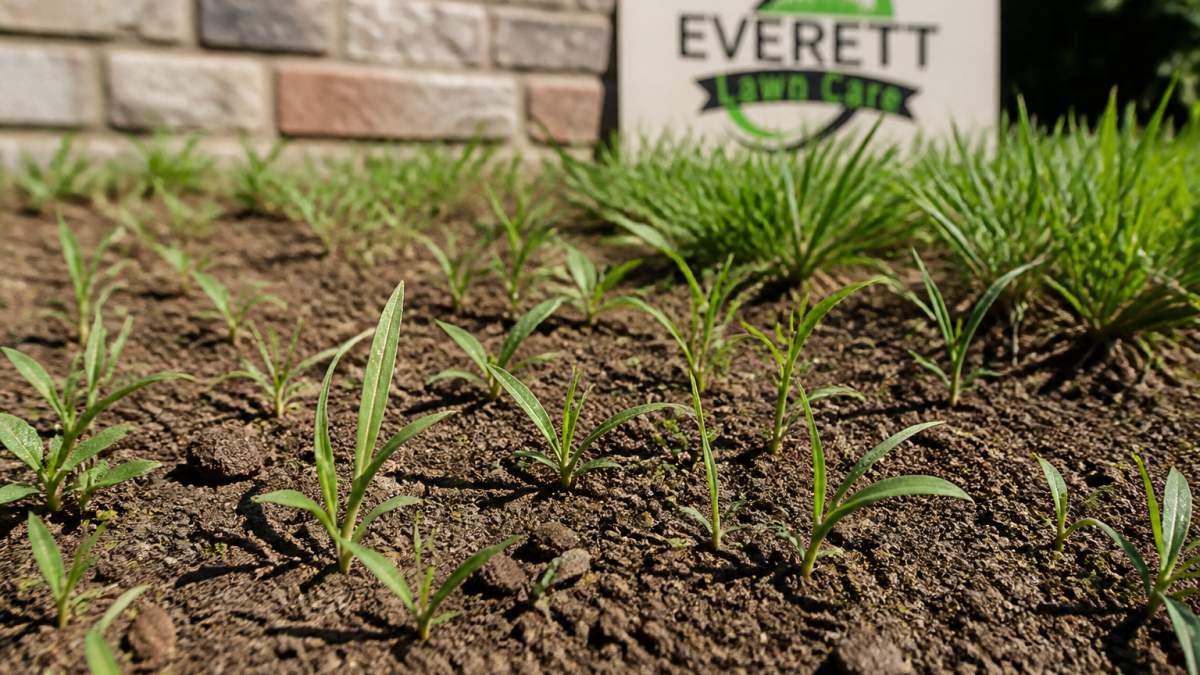
Diagram illustrating how the crabgrass seed bank causes crabgrass keeps coming back in thin, bare lawn patches.

A single plant produces thousands of seeds, so years of untreated infestation build a massive reserve, one year of treatment rarely solves the problem permanently.

The seed bank is the core reason why crabgrass keeps coming back: you're fighting years of accumulated seeds, not just this year's weeds.

How Soil Temperature and Seasonal Germination Trigger Crabgrass Growth

Most species germinate when soil temperature holds around 55-60 degrees Fahrenheit for several consecutive days, typically in spring.

Wait until you see crabgrass and the seeds have already germinated, which is why pre-emergent timing is critical.

Warm, dry summers favor crabgrass, which thrives in heat and drought stress while desirable turf weakens.

The cycle is predictable, so without intervention it repeats indefinitely.

Why Crabgrass Returns After Treatment

Post-emergent herbicides kill mature crabgrass well but do nothing to prevent new seeds from germinating next year.

Thin, weak turf can't resist reinfestation: bare spots invite new seeds, and if your lawn doesn't recover after treatment, crabgrass colonizes again easily.

That's why crabgrass keeps coming back after treatment: you need both immediate removal and long-term prevention to break the cycle.

Crabgrass Pre-Emergent Timing and Application Windows

Pre-emergent herbicide is your best defense because it stops seeds from germinating, but it only works inside a narrow window set by soil temperature at the 1-to-2-inch depth where seeds sit.

Measure soil temperature, not the calendar

Most extension guidance ties germination to soil holding around 55 F for several consecutive days at a 2-inch depth. The protocol:

  • Use a dial or digital soil thermometer, not an air thermometer. Insert the probe 2 inches deep, wait 60 seconds, and read it.
  • Measure in the same three or four spots each time, one sunny, one shaded, one thin, one thick, and average them. Shaded and thin areas warm more slowly and often germinate later.
  • Take readings in the early afternoon, when soil is near its daily high, and record them. A single warm day means nothing; you are looking for a sustained trend.

The pre-emergent window typically opens two to three weeks before soil reaches the threshold and closes once seedlings emerge, making "before weed emergence" a deadline, not a suggestion.

How the window shifts by region

The same product on the same date behaves differently by region because soil warms on different schedules:

  • Cool-season transition and northern lawns: The window typically opens in early to mid-spring and can run into late spring. A split application, one at the front of the window and a second six to eight weeks later, is common where spring is long and cool.
  • Warm-season and southern lawns: Soil can cross the threshold in late winter or very early spring, and crabgrass may germinate in multiple flushes through the season. Two applications, or a granular product with a longer residual, are more typical.
  • Coastal and high-elevation lawns: Fog, marine layers, and elevation delay soil warming. Calendar-based advice borrowed from a neighboring region often misses by two to four weeks.
Pro Tip Build a simple log: date, average 2-inch soil temperature, and what you saw in the lawn. After one season you will know your property's real window better than any generic calendar.

Active ingredients, rates, and re-application

Pre-emergent products for lawns generally fall into a few active-ingredient families, and the label, not a blog, governs the rate:

  • Prodiamine and pendimethalin are common granular and liquid pre-emergents with residual activity measured in weeks to a few months. They are typically applied at a labeled rate per 1,000 square feet and watered in to activate the barrier.
  • Dithiopyr is often chosen where the window is missed slightly because it has some early post-emergent activity on very young seedlings.
  • Isoxaben and other broadleaf-focused products are not crabgrass materials and should not be substituted.

Application rules that matter more than the product name:

  • Rate: Apply at the label rate for your grass species and your region. Doubling the rate does not double the control; it increases the risk of turf injury and runoff.
  • Water-in: Granular pre-emergents usually need about 0.5 inch of irrigation or rainfall within a day or two to activate. Too little water leaves the barrier on the surface; too much in one event can move it below the seed zone.
  • Re-application interval: Respect the label's minimum interval and seasonal maximum. Split applications are usually two half-rates spaced per the label, not two full rates.
Watch Out Pre-emergent cannot stop seeds that have already germinated. If you see crabgrass seedlings, switch to a post-emergent labeled for your grass type and save the pre-emergent plan for the next window.

Why the window is easy to miss

The most common failure is applying by date instead of soil temperature: a cool snap keeps soil below threshold for weeks, the barrier degrades, and crabgrass germinates after the product weakens. The second is a single application where two are needed; the third is skipping the water-in step, leaving the barrier inactive.

Get the measurement, split timing, and label rate right and you prevent most germination; miss any one and you spend the season fighting established crabgrass.

Instant Estimate →

How to Kill Crabgrass Without Killing Grass

When crabgrass appears, remove it without damaging desirable turf by choosing the right herbicide and technique.

Post-emergents are selective or non-selective. Selective herbicides target crabgrass while leaving lawn grass unharmed; non-selective kill everything they touch.

For specific removal methods and techniques, how to get rid of crabgrass in your lawn provides detailed guidance on eliminating existing crabgrass effectively.

Some herbicides damage certain grass types, so check your species and spot-test a small area if unsure.

For small infestations, hand-pull crabgrass and get the entire root system to prevent regrowth; for large ones, herbicide is more practical.

Lawn Care for Crabgrass Prevention and Long-Term Control

Herbicide buys you a season; lawn care changes the outcome over several. Most recurring problems have one or two specific causes, so diagnose before buying another product.

Diagnosis checklist for recurring infestations

Answer these in order. The first "yes" is usually your primary cause.

  1. Did you miss the pre-emergent window? If you applied by calendar date rather than soil temperature, or applied only once in a region that needs a split application, timing is your cause. Fix the timing protocol before changing products.
  2. Did crabgrass go to seed last year? If you saw seed heads before you treated, you added thousands of seeds per plant to the bank. Expect two to three seasons of prevention before the population drops noticeably.
  3. Is your turf thin or bare in the sunny areas? Crabgrass is a sun-loving pioneer. Thin turf in full sun is an invitation. Overseeding and fertility are the fix, not more herbicide.
  4. Is the soil compacted? Compacted soil sheds water, starves roots, and keeps turf thin. A screwdriver or soil probe pushed into the turf tells you quickly, if it resists, plan aeration.
  5. Are you watering shallowly and often? Frequent light watering keeps moisture in the top inch, which favors crabgrass roots and weakens deep-rooted turf. Switch to deep, infrequent watering.
  6. Are you mowing too short? Scalping exposes soil to light and heat. Raise the deck to the tall end of the range for your grass species.
  7. Is the pH or fertility off? A soil test is the only way to know. Acidic or nutrient-poor soil produces weak turf regardless of how well you mow and water.
Key Takeaway If you cannot name which of these seven is your cause, you are guessing. One soil test, one thermometer log, and one probe test will usually identify it in a single season.

The practices that actually thicken turf

Once you know the cause, these are the levers that matter:

  • Mowing height: Keep cool-season lawns at roughly 3 to 4 inches and warm-season lawns at the tall end of their recommended range. Taller grass shades the soil surface and reduces crabgrass germination. Never remove more than about one-third of the blade height in a single cut.
  • Watering depth: Apply about 1 to 1.5 inches per week, including rainfall, in one or two deep sessions rather than daily light sprinkling. Deep watering builds deep roots in desirable grass; crabgrass has a shallow root system and gains no advantage from it.
  • Aeration: Core aeration relieves compaction and opens the soil for roots and water. Cool-season lawns are typically aerated in early fall; warm-season lawns in late spring to early summer. Avoid aerating right after a pre-emergent application, which can break the barrier.
Practice Best timing What it fixes
Soil test Spring or fall pH and nutrient deficiencies
Pre-emergent (split) Soil-temperature window New germination
Core aeration Early fall (cool-season); late spring (warm-season) Compaction, water movement
Overseeding Early fall (cool-season); spring (warm-season) Thin and bare turf
Mowing at tall end of range Year-round Light reaching soil
Deep, infrequent watering Growing season Root depth

A realistic multi-season plan

The seed bank does not empty in one year. A workable expectation:

  • Season 1, stop the additions. Nail the pre-emergent window, treat escapes with a labeled post-emergent before they set seed, and fix the single biggest cultural problem (usually compaction or thin turf).
  • Season 2, thicken the turf. Overseed or repair bare spots, correct pH and fertility per the soil test, and hold the mowing and watering discipline. Expect fewer plants but not zero.
  • Season 3, monitor and spot-treat. Continue prevention, walk the lawn monthly during the growing season, and hand-pull or spot-treat early escapes. By this point the population should be visibly declining.
Watch Out Do not promise yourself a one-time fix. Crabgrass seeds remain viable in soil for years, and any bare patch or missed window can restart the cycle. The goal is a shrinking population and a thickening lawn, season over season.

For region-specific support, seasonal fertilization for fescue explains how treatment timing strengthens turf year-round, and lawn aeration for landscaping shows how aerating compacted soil deepens roots and thickens turf.

Healthy soil grows dense turf that crowds out weeds; a soil test reveals what your lawn needs.

The key insight: prevention means building a lawn healthy enough that crabgrass can't take hold, and diagnosing which weakness lets it in, a multi-season plan, not just spraying.

Getting Professional Help to Break the Crabgrass Cycle

Sometimes infestations are too severe to handle alone, and professionals have the tools, expertise, and equipment homeowners lack.

Professionals address the seed bank systematically over multiple seasons, coordinating pre-emergent timing, post-emergent treatment, and lawn strengthening.

Verify a service is licensed and insured, and ask whether they only kill weeds or also strengthen your lawn, the best do both.

For property owners ready to hire professionals, licensed and insured lawn care services explains what to expect from professional lawn care and what credentials matter.

At Everett Lawn Care, we break the crabgrass cycle by combining targeted treatment with long-term lawn strengthening.


Frequently Asked Questions

Why does crabgrass return after treatment?

Crabgrass returns after treatment because seeds in the soil continue to germinate over time. A single crabgrass plant produces thousands of seeds that can remain dormant in the soil for years. Post-emergent herbicides kill existing plants but don't prevent new seeds from sprouting when soil temperature reaches the right threshold. Without a pre-emergent barrier applied at the correct time, new seedlings will emerge throughout the growing season, making the infestation seem to return repeatedly.

When should you apply crabgrass preventer?

Apply crabgrass pre-emergent herbicide when soil temperature reaches the appropriate threshold for several consecutive days in spring. The herbicide creates a barrier that prevents crabgrass seeds from germinating. Timing is critical because pre-emergent only works before seeds sprout, not after seedlings emerge.

What kills crabgrass without killing the lawn?

Post-emergent herbicides with selective active ingredients target crabgrass while leaving desirable turfgrass unharmed. Apply these only to actively growing crabgrass seedlings in late spring or early summer when they are young and tender. Mature crabgrass is harder to kill, so early treatment is more effective. Always follow label directions carefully and avoid application during heat stress or drought, which can damage your lawn.

Can a thick lawn keep crabgrass from growing?

Yes, a dense, healthy lawn significantly reduces crabgrass pressure. Crabgrass thrives in thin turf, bare spots, and compacted soil where competition is weak. Building lawn density through proper mowing height, deep watering, soil aeration, and overseeding creates an environment hostile to crabgrass germination. Healthy grass roots occupy soil space and shade the soil surface, making it harder for crabgrass seeds to establish. This is why lawn care for crabgrass prevention includes both weed control and turf strengthening.

GoogleAdd everett-lawncare.com as a preferred source on Google →

Why Crabgrass Keeps Coming Back to Your Lawn

By Everett McLain

Last Updated: October 26, 2026

Quick Summary

Crabgrass keeps coming back because your soil holds thousands of dormant seeds that survive for years, even decades, waiting for the right soil temperature to germinate. A single plant produces thousands of seeds, so years of untreated infestation build a massive reserve that one year of treatment rarely solves permanently.

  • Crabgrass seeds germinate when soil temperature holds around 55-60 degrees Fahrenheit for several consecutive days, typically in spring.
  • Post-emergent herbicides kill visible crabgrass but do nothing to prevent new seeds from germinating next year.
  • Pre-emergent herbicide stops seeds from germinating but only works inside a narrow window set by soil temperature at the 2-inch depth.
  • Thin, weak turf cannot resist reinfestation; bare spots invite new seeds and crabgrass colonizes easily after treatment.
  • Breaking the cycle requires a multi-season plan: stop new additions in year one, thicken turf in year two, and monitor and spot-treat in year three.

Table of Contents

Understanding the Crabgrass Seed Bank and Why It Persists

That persistent supply is the seed bank: every plant drops seeds before dying, and they stay viable underground even after you kill every visible plant.

Diagram illustrating how the crabgrass seed bank causes crabgrass keeps coming back in thin, bare lawn patches.

A single plant produces thousands of seeds, so years of untreated infestation build a massive reserve, one year of treatment rarely solves the problem permanently.

The seed bank is the core reason why crabgrass keeps coming back: you're fighting years of accumulated seeds, not just this year's weeds.

How Soil Temperature and Seasonal Germination Trigger Crabgrass Growth

Most species germinate when soil temperature holds around 55-60 degrees Fahrenheit for several consecutive days, typically in spring.

Wait until you see crabgrass and the seeds have already germinated, which is why pre-emergent timing is critical.

Warm, dry summers favor crabgrass, which thrives in heat and drought stress while desirable turf weakens.

The cycle is predictable, so without intervention it repeats indefinitely.

Why Crabgrass Returns After Treatment

Post-emergent herbicides kill mature crabgrass well but do nothing to prevent new seeds from germinating next year.

Thin, weak turf can't resist reinfestation: bare spots invite new seeds, and if your lawn doesn't recover after treatment, crabgrass colonizes again easily.

That's why crabgrass keeps coming back after treatment: you need both immediate removal and long-term prevention to break the cycle.

Crabgrass Pre-Emergent Timing and Application Windows

Pre-emergent herbicide is your best defense because it stops seeds from germinating, but it only works inside a narrow window set by soil temperature at the 1-to-2-inch depth where seeds sit.

Measure soil temperature, not the calendar

Most extension guidance ties germination to soil holding around 55 F for several consecutive days at a 2-inch depth. The protocol:

  • Use a dial or digital soil thermometer, not an air thermometer. Insert the probe 2 inches deep, wait 60 seconds, and read it.
  • Measure in the same three or four spots each time, one sunny, one shaded, one thin, one thick, and average them. Shaded and thin areas warm more slowly and often germinate later.
  • Take readings in the early afternoon, when soil is near its daily high, and record them. A single warm day means nothing; you are looking for a sustained trend.

The pre-emergent window typically opens two to three weeks before soil reaches the threshold and closes once seedlings emerge, making "before weed emergence" a deadline, not a suggestion.

How the window shifts by region

The same product on the same date behaves differently by region because soil warms on different schedules:

  • Cool-season transition and northern lawns: The window typically opens in early to mid-spring and can run into late spring. A split application, one at the front of the window and a second six to eight weeks later, is common where spring is long and cool.
  • Warm-season and southern lawns: Soil can cross the threshold in late winter or very early spring, and crabgrass may germinate in multiple flushes through the season. Two applications, or a granular product with a longer residual, are more typical.
  • Coastal and high-elevation lawns: Fog, marine layers, and elevation delay soil warming. Calendar-based advice borrowed from a neighboring region often misses by two to four weeks.
Pro Tip Build a simple log: date, average 2-inch soil temperature, and what you saw in the lawn. After one season you will know your property's real window better than any generic calendar.

Active ingredients, rates, and re-application

Pre-emergent products for lawns generally fall into a few active-ingredient families, and the label, not a blog, governs the rate:

  • Prodiamine and pendimethalin are common granular and liquid pre-emergents with residual activity measured in weeks to a few months. They are typically applied at a labeled rate per 1,000 square feet and watered in to activate the barrier.
  • Dithiopyr is often chosen where the window is missed slightly because it has some early post-emergent activity on very young seedlings.
  • Isoxaben and other broadleaf-focused products are not crabgrass materials and should not be substituted.

Application rules that matter more than the product name:

  • Rate: Apply at the label rate for your grass species and your region. Doubling the rate does not double the control; it increases the risk of turf injury and runoff.
  • Water-in: Granular pre-emergents usually need about 0.5 inch of irrigation or rainfall within a day or two to activate. Too little water leaves the barrier on the surface; too much in one event can move it below the seed zone.
  • Re-application interval: Respect the label's minimum interval and seasonal maximum. Split applications are usually two half-rates spaced per the label, not two full rates.
Watch Out Pre-emergent cannot stop seeds that have already germinated. If you see crabgrass seedlings, switch to a post-emergent labeled for your grass type and save the pre-emergent plan for the next window.

Why the window is easy to miss

The most common failure is applying by date instead of soil temperature: a cool snap keeps soil below threshold for weeks, the barrier degrades, and crabgrass germinates after the product weakens. The second is a single application where two are needed; the third is skipping the water-in step, leaving the barrier inactive.

Get the measurement, split timing, and label rate right and you prevent most germination; miss any one and you spend the season fighting established crabgrass.

Instant Estimate →

How to Kill Crabgrass Without Killing Grass

When crabgrass appears, remove it without damaging desirable turf by choosing the right herbicide and technique.

Post-emergents are selective or non-selective. Selective herbicides target crabgrass while leaving lawn grass unharmed; non-selective kill everything they touch.

For specific removal methods and techniques, how to get rid of crabgrass in your lawn provides detailed guidance on eliminating existing crabgrass effectively.

Some herbicides damage certain grass types, so check your species and spot-test a small area if unsure.

For small infestations, hand-pull crabgrass and get the entire root system to prevent regrowth; for large ones, herbicide is more practical.

Lawn Care for Crabgrass Prevention and Long-Term Control

Herbicide buys you a season; lawn care changes the outcome over several. Most recurring problems have one or two specific causes, so diagnose before buying another product.

Diagnosis checklist for recurring infestations

Answer these in order. The first "yes" is usually your primary cause.

  1. Did you miss the pre-emergent window? If you applied by calendar date rather than soil temperature, or applied only once in a region that needs a split application, timing is your cause. Fix the timing protocol before changing products.
  2. Did crabgrass go to seed last year? If you saw seed heads before you treated, you added thousands of seeds per plant to the bank. Expect two to three seasons of prevention before the population drops noticeably.
  3. Is your turf thin or bare in the sunny areas? Crabgrass is a sun-loving pioneer. Thin turf in full sun is an invitation. Overseeding and fertility are the fix, not more herbicide.
  4. Is the soil compacted? Compacted soil sheds water, starves roots, and keeps turf thin. A screwdriver or soil probe pushed into the turf tells you quickly, if it resists, plan aeration.
  5. Are you watering shallowly and often? Frequent light watering keeps moisture in the top inch, which favors crabgrass roots and weakens deep-rooted turf. Switch to deep, infrequent watering.
  6. Are you mowing too short? Scalping exposes soil to light and heat. Raise the deck to the tall end of the range for your grass species.
  7. Is the pH or fertility off? A soil test is the only way to know. Acidic or nutrient-poor soil produces weak turf regardless of how well you mow and water.
Key Takeaway If you cannot name which of these seven is your cause, you are guessing. One soil test, one thermometer log, and one probe test will usually identify it in a single season.

The practices that actually thicken turf

Once you know the cause, these are the levers that matter:

  • Mowing height: Keep cool-season lawns at roughly 3 to 4 inches and warm-season lawns at the tall end of their recommended range. Taller grass shades the soil surface and reduces crabgrass germination. Never remove more than about one-third of the blade height in a single cut.
  • Watering depth: Apply about 1 to 1.5 inches per week, including rainfall, in one or two deep sessions rather than daily light sprinkling. Deep watering builds deep roots in desirable grass; crabgrass has a shallow root system and gains no advantage from it.
  • Aeration: Core aeration relieves compaction and opens the soil for roots and water. Cool-season lawns are typically aerated in early fall; warm-season lawns in late spring to early summer. Avoid aerating right after a pre-emergent application, which can break the barrier.
Practice Best timing What it fixes
Soil test Spring or fall pH and nutrient deficiencies
Pre-emergent (split) Soil-temperature window New germination
Core aeration Early fall (cool-season); late spring (warm-season) Compaction, water movement
Overseeding Early fall (cool-season); spring (warm-season) Thin and bare turf
Mowing at tall end of range Year-round Light reaching soil
Deep, infrequent watering Growing season Root depth

A realistic multi-season plan

The seed bank does not empty in one year. A workable expectation:

  • Season 1, stop the additions. Nail the pre-emergent window, treat escapes with a labeled post-emergent before they set seed, and fix the single biggest cultural problem (usually compaction or thin turf).
  • Season 2, thicken the turf. Overseed or repair bare spots, correct pH and fertility per the soil test, and hold the mowing and watering discipline. Expect fewer plants but not zero.
  • Season 3, monitor and spot-treat. Continue prevention, walk the lawn monthly during the growing season, and hand-pull or spot-treat early escapes. By this point the population should be visibly declining.
Watch Out Do not promise yourself a one-time fix. Crabgrass seeds remain viable in soil for years, and any bare patch or missed window can restart the cycle. The goal is a shrinking population and a thickening lawn, season over season.

For region-specific support, seasonal fertilization for fescue explains how treatment timing strengthens turf year-round, and lawn aeration for landscaping shows how aerating compacted soil deepens roots and thickens turf.

Healthy soil grows dense turf that crowds out weeds; a soil test reveals what your lawn needs.

The key insight: prevention means building a lawn healthy enough that crabgrass can't take hold, and diagnosing which weakness lets it in, a multi-season plan, not just spraying.

Getting Professional Help to Break the Crabgrass Cycle

Sometimes infestations are too severe to handle alone, and professionals have the tools, expertise, and equipment homeowners lack.

Professionals address the seed bank systematically over multiple seasons, coordinating pre-emergent timing, post-emergent treatment, and lawn strengthening.

Verify a service is licensed and insured, and ask whether they only kill weeds or also strengthen your lawn, the best do both.

For property owners ready to hire professionals, licensed and insured lawn care services explains what to expect from professional lawn care and what credentials matter.

At Everett Lawn Care, we break the crabgrass cycle by combining targeted treatment with long-term lawn strengthening.


Frequently Asked Questions

Why does crabgrass return after treatment?

Crabgrass returns after treatment because seeds in the soil continue to germinate over time. A single crabgrass plant produces thousands of seeds that can remain dormant in the soil for years. Post-emergent herbicides kill existing plants but don't prevent new seeds from sprouting when soil temperature reaches the right threshold. Without a pre-emergent barrier applied at the correct time, new seedlings will emerge throughout the growing season, making the infestation seem to return repeatedly.

When should you apply crabgrass preventer?

Apply crabgrass pre-emergent herbicide when soil temperature reaches the appropriate threshold for several consecutive days in spring. The herbicide creates a barrier that prevents crabgrass seeds from germinating. Timing is critical because pre-emergent only works before seeds sprout, not after seedlings emerge.

What kills crabgrass without killing the lawn?

Post-emergent herbicides with selective active ingredients target crabgrass while leaving desirable turfgrass unharmed. Apply these only to actively growing crabgrass seedlings in late spring or early summer when they are young and tender. Mature crabgrass is harder to kill, so early treatment is more effective. Always follow label directions carefully and avoid application during heat stress or drought, which can damage your lawn.

Can a thick lawn keep crabgrass from growing?

Yes, a dense, healthy lawn significantly reduces crabgrass pressure. Crabgrass thrives in thin turf, bare spots, and compacted soil where competition is weak. Building lawn density through proper mowing height, deep watering, soil aeration, and overseeding creates an environment hostile to crabgrass germination. Healthy grass roots occupy soil space and shade the soil surface, making it harder for crabgrass seeds to establish. This is why lawn care for crabgrass prevention includes both weed control and turf strengthening.

GoogleAdd everett-lawncare.com as a preferred source on Google →

Everett Lawn Care

Loading your experience…

Please wait — this usually finishes in a few seconds.